Topics

Vector Product
0 of 0 exercises completed
The vector (aka cross) product u×v and its connection to areas in 3D space.
Want a deeper conceptual understanding? Try our interactive lesson!
Vector product
AHL 3.16
The vector product, sometimes called the cross product, of two vectors v and w is given by:
v×w=⎝⎛v2w3−v3w2v3w1−v1w3v1w2−v2w1⎠⎞📖
This vector is perpendicular to both original vectors. Using the right-hand rule, if your index finger points in the direction of v and your middle finger points towards w, your thumb points towards v×w. The vector product thus creates a new vector perpendicular to both original vectors.
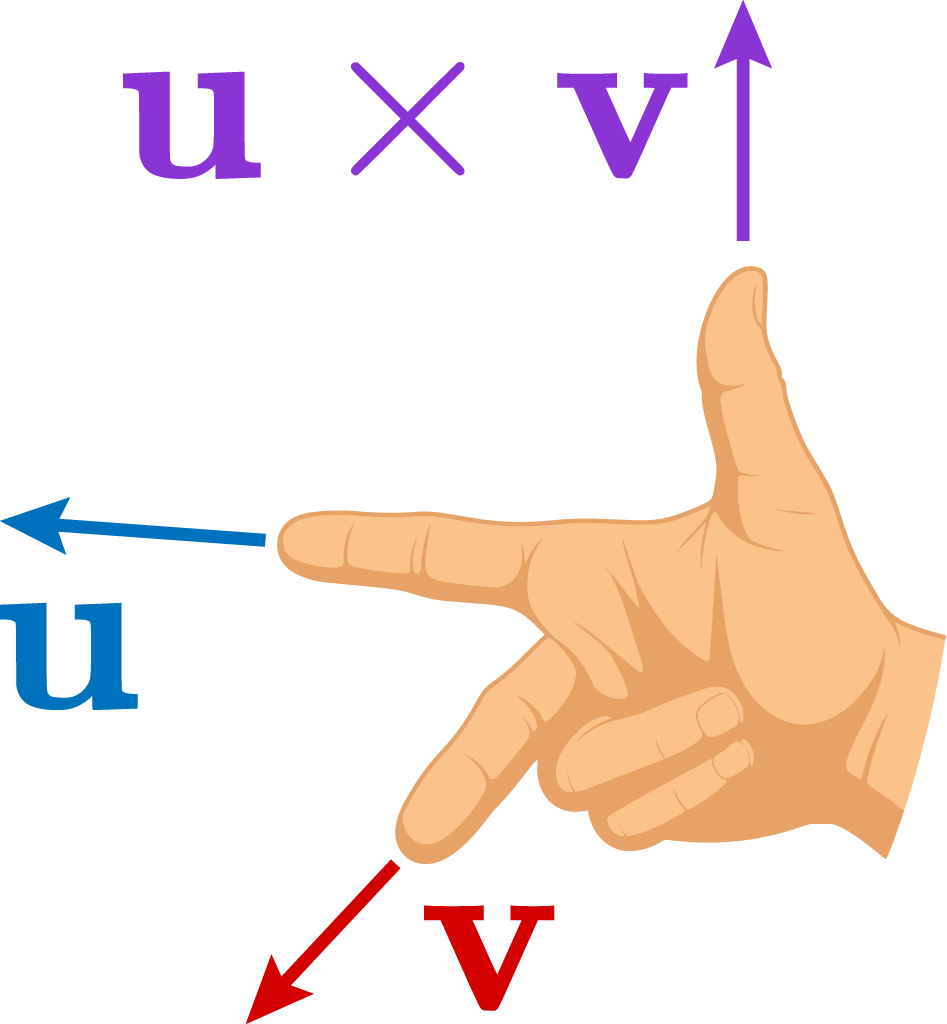
The vector product measures the extent to which two vectors have different directions. The bigger the vectors and the more they point in different directions, the bigger the area between them and therefore the bigger the vector product. Only the "perpendicular parts" contribute to the vector product. It's a vector quantity measuring the direction of difference.
Vector areas with cross product
AHL 3.16
The magnitude of the vector product v×w gives the area of the parallelogram formed by vectors v and w:
Area=∣v×w∣📖
Intuitively, this happens because the magnitude combines both vectors’ lengths and how "spread out" they are from each other, capturing exactly the amount of two-dimensional space they span.
Vector product and sin of angle
AHL 3.16
The magnitude of the vector product is connected to the sine of the angle between the vectors by the formula
∣v×w∣=∣v∣∣w∣sinθ📖
Here, θ is the angle between vectors v and w. This relationship holds because the area of the parallelogram formed by the two vectors depends on their lengths and the angle separating them.
Specifically, the area is largest when the vectors are perpendicular (sin90∘=1) and zero when they are parallel (sin0∘=0).
Components of vectors
AHL 3.16
For two vectors a and b, the magnitude of the component of vector a that acts in the direction of vector b is given by
∣a∣cosθ=∣b∣a⋅b
The magnitude of the component of vector a that acts perpendicular to vector b, in the plane formed by the two vectors, is given by
∣a∣sinθ=∣b∣∣a×b∣
where θ is the angle between the two vectors.
Properties of the vector product
AHL 3.16
For any vectors u, v, and w, and scalar k:
u×v=−(v×u)🚫
u×(v+w)=u×v+u×w🚫
(ku)×v=k(u×v)=u×(kv)🚫
u×u=0🚫
u×v=0⇒u∥v for non-zerou,v🚫
Nice work completing Vector Product, here's a quick recap of what we covered:
Skills covered
Exercises checked off
I'm Plex, here to help you understand this concept!