Topics

Angles and intersections with planes
0 of 0 exercises completed
Finding angles between lines, between a line and a plane, and between two planes using direction vectors and normals, plus intersections of lines and planes and systems of three planes in 3D.
Want a deeper conceptual understanding? Try our interactive lesson! (Plus Only)
Intersection of line and plane
AHL 3.18
To find the intersection of a line and a plane, substitute the vector line equation into the plane equation and solve for the parameter λ.
Angle between line and plane
AHL 3.18
The angle ϕ between a line and a plane is measured as the complement of the angle between the line’s direction vector d and the plane’s normal vector n.
Since the normal forms an angle of 90° with the plane, we can construct a right angled triangle using the intersection of the normal, the line, and the plane:
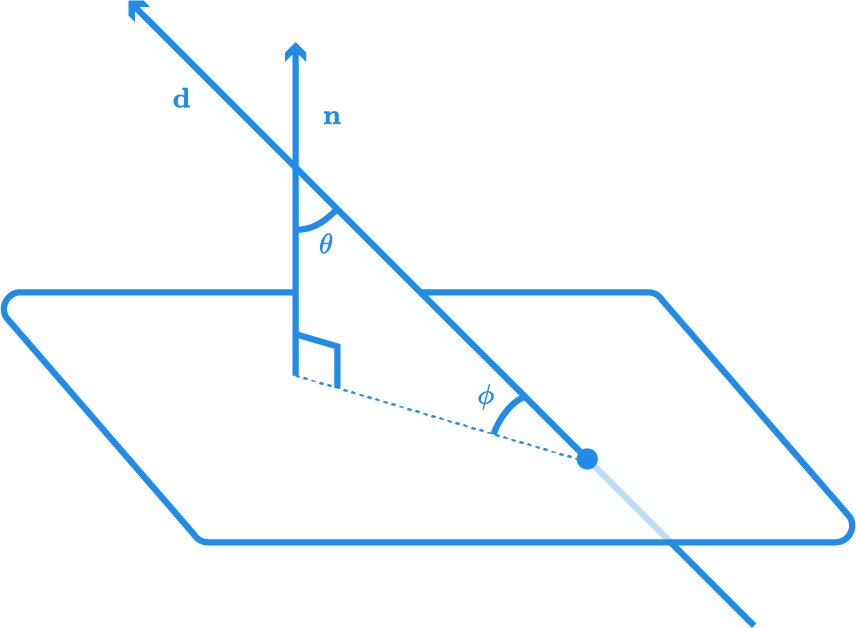
If θ is the angle between d and n, then ϕ=180°−90∘−θ=90°−θ
In practice, you can compute θ using cosθ=∣d∣∣n∣d⋅n.
Intersection between 2 planes
AHL 3.18
The intersection of 2 planes - if they are not parallel - is a line. We can find the line intersection by solving a system of equations.
Angle between 2 planes
AHL 3.18
The angle θ between two planes can be found by computing the angle between the two plane normals:
θ=arccos(∣n1∣∣n2∣n1⋅n2)
The diagram below illustrates why this works. Note that the formula above gives the angle between the "heads" of the normal vectors, which can either be acute or obtuse. Just like the angle between lines, if the question asks for an acute angle and cos−1 returns an obtuse angle, just subtract it from 180∘ to get the acute angle.
Solving systems of equations with 3 unknowns
AHL AA 1.16
Systems of 3 equations with 3 unknowns, for example
(1)(2)(3)⎩⎪⎨⎪⎧2x−3y+4z=85x+2y−z=63x+4y+2z=17
can be solved with a calculator, or by using substitution.
Worked solution
For the system above, equation (2) is a convenient place to start, because it contains just −z, so it is easy to rearrange for z:
z=5x+2y−6
Now substitute this expression for z into equations (1) and (3).
2x−3y+4(5x+2y−6)=8
22x+5y=32
Using equation (3):
3x+4y+2(5x+2y−6)=17
13x+8y=29
We know have a system of 2 equations with 2 unknowns. Eliminate y by taking
8(22x+5y)−5(13x+8y)=8⋅32−5⋅29
176x+40y−65x−40y=256−145
111x=111
x=1
Now substitute x=1 into 13x+8y=29:
13(1)+8y=29
y=2
Finally, substitute x=1 and y=2 into z=5x+2y−6:
z=5(1)+2(2)−6
z=3
So the solution is x=1,y=2,z=3.
Solution count for 3 by 3 systems of equations
AHL AA 1.16
A system of 3 equations with 3 unknowns can have
no solutions
a unique solution
infinitely many solutions
Example
Consider the system of equations
(1)(2)(3)⎩⎪⎨⎪⎧x+2y−z=1−x−y−z=−1x+ay+2z=2
Add equations (1) and (2):
y−2z=0
y=2z
Now add equations (2) and (3):
(a−1)y+z=1
Substitute y=2z:
(a−1)(2z)+z=1
(2a−1)z=1
If 2a−1=0, then we can solve for
z=2a−11
and then find y and z. This represents a unique solution.
But if 2a−1=0, ie a=21, then we have 0z=1, to which there are no solutions.
Intersection of 3 planes
AHL 3.18
When three planes are considered together, their intersection in 3D space can take several forms:
A plane if all three planes coincide.
A single point if the three planes intersect uniquely, meaning their normal vectors are not all parallel or in some degenerate arrangement, and the system of equations has exactly one solution.
A line if two planes intersect in a line and the third plane also contains that line (or if each pair of planes meets along the same line).
No intersection if the system of equations is inconsistent (e.g., the planes are arranged in parallel or partially parallel ways that do not share a common point).
Nice work completing Angles and intersections with planes, here's a quick recap of what we covered:
Skills covered
Exercises checked off
I'm Plex, here to help you understand this concept!