Perplex
  • Dashboard
Topics
Exponents & LogarithmsRounding & ErrorSequences & SeriesFinancial Mathematics
Cartesian plane & linesFunction TheoryModelling
2D & 3D GeometryVoronoi Diagrams
ProbabilityDescriptive StatisticsBivariate StatisticsDistributions & Random VariablesInference & Hypotheses
DifferentiationIntegration
Calculator Skills
Review VideosFormula BookletAll Study Sets
BlogLanding Page
Sign UpLogin
Perplex
Perplex
  • Dashboard
Topics
Exponents & LogarithmsRounding & ErrorSequences & SeriesFinancial Mathematics
Cartesian plane & linesFunction TheoryModelling
2D & 3D GeometryVoronoi Diagrams
ProbabilityDescriptive StatisticsBivariate StatisticsDistributions & Random VariablesInference & Hypotheses
DifferentiationIntegration
Calculator Skills
Review VideosFormula BookletAll Study Sets
BlogLanding Page
Sign UpLogin
Perplex
/
Financial Mathematics
/
Loans
Annuities
Loans
Financial Mathematics

Loans

0 of 0 exercises completed

Loans as amortized borrowing: money is received as an initial balance and repaid by regular payments with interest until the balance is cleared, using TVM Solver variables such as ​PV,  ​PMT,  ​FV,  ​N,  ​I%,  ​P/Y​ and ​C/Y, with correct positive and negative cash flow signs.

Want a deeper conceptual understanding? Try our interactive lesson!

Definition of a loan / amortization
SL AI 1.7

A loan is when money is borrowed and later repaid over time. In the IB (and most real world settings), the person who borrows money agrees to make a payment at regular intervals (for example monthly or yearly).


As a reward for the person who lends (gives) the money, the borrower also pays interest, typically a percentage of the loan amount. The payment amount is calculated such that the loan is fully repaid (with interest) by the end of an agreed upon period of time.

Example

James borrows ​$10000​ from a dealership to buy a car. Under the terms of the loan, the loan must be repaid within ​4​ years. The interest rate is ​6%, compounded monthly. Calculate the monthly payment James must make.


The calculation of the payment is somewhat complex, but the IB does not require you to do it by hand. Instead, you will use the finance app (sometimes called TVM solver) on your calculator. The following interactive simulation does essentially what the calculator does, but displays it graphically. By setting the interest rate and payments per year, and then moving around the payment value, you'll find that a monthly payment of roughly ​$244​ leads to the balance becomung zero after exactly


Positive & Negative Cash Flows (TVM)
SL Core 1.4

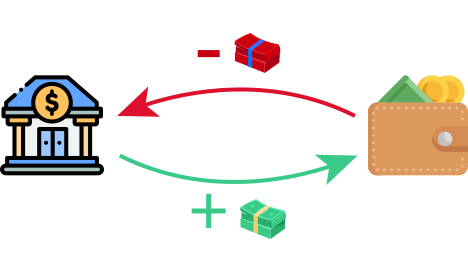
Whenever you use the Finance App (TVM Solver) on your calculator, it's critical that you enter and interpret the signs correctly:
problem image

When you receive money from a bank or savings account, that value is positive, because you're gaining money.


When you send money to a bank, that value is negative, because you're losing money.

Using TVM Solver (Calculator) - Loans
SL Core 1.4

In IB, loans are paid off at the end of a number of periods (​N​) and have an annual interest rate (​I%​), an initial balance (​PV​), a fixed payment (​PMT​), and an outstanding balance (​FV​). Payments per year and compounds per year typically occur at the same frequency (​P/Y,  ​C/Y​).


You can use the TVM solver with loans to find any of those variables if you know all the others.

Nice work completing Loans, here's a quick recap of what we covered:

Skills covered

Mixed Practice

Exercises checked off

I'm Plex, here to help you understand this concept!
/
Financial Mathematics
/
Loans
Annuities
Loans
Financial Mathematics

Loans

0 of 0 exercises completed

Loans as amortized borrowing: money is received as an initial balance and repaid by regular payments with interest until the balance is cleared, using TVM Solver variables such as ​PV,  ​PMT,  ​FV,  ​N,  ​I%,  ​P/Y​ and ​C/Y, with correct positive and negative cash flow signs.

Want a deeper conceptual understanding? Try our interactive lesson!

Definition of a loan / amortization
SL AI 1.7

A loan is when money is borrowed and later repaid over time. In the IB (and most real world settings), the person who borrows money agrees to make a payment at regular intervals (for example monthly or yearly).


As a reward for the person who lends (gives) the money, the borrower also pays interest, typically a percentage of the loan amount. The payment amount is calculated such that the loan is fully repaid (with interest) by the end of an agreed upon period of time.

Example

James borrows ​$10000​ from a dealership to buy a car. Under the terms of the loan, the loan must be repaid within ​4​ years. The interest rate is ​6%, compounded monthly. Calculate the monthly payment James must make.


The calculation of the payment is somewhat complex, but the IB does not require you to do it by hand. Instead, you will use the finance app (sometimes called TVM solver) on your calculator. The following interactive simulation does essentially what the calculator does, but displays it graphically. By setting the interest rate and payments per year, and then moving around the payment value, you'll find that a monthly payment of roughly ​$244​ leads to the balance becomung zero after exactly


Positive & Negative Cash Flows (TVM)
SL Core 1.4

Whenever you use the Finance App (TVM Solver) on your calculator, it's critical that you enter and interpret the signs correctly:

problem image

When you receive money from a bank or savings account, that value is positive, because you're gaining money.


When you send money to a bank, that value is negative, because you're losing money.

Using TVM Solver (Calculator) - Loans
SL Core 1.4

In IB, loans are paid off at the end of a number of periods (​N​) and have an annual interest rate (​I%​), an initial balance (​PV​), a fixed payment (​PMT​), and an outstanding balance (​FV​). Payments per year and compounds per year typically occur at the same frequency (​P/Y,  ​C/Y​).


You can use the TVM solver with loans to find any of those variables if you know all the others.

Nice work completing Loans, here's a quick recap of what we covered:

Skills covered

Mixed Practice

Exercises checked off

I'm Plex, here to help you understand this concept!

Generating starter questions...

1 free

Generating starter questions...

1 free