Topics

Compounding (Appreciation & Depreciation)
0 of 0 exercises completed
Compound growth, depreciation, interest, inflation, real value
Want a deeper conceptual understanding? Try our interactive lesson! (Plus Only)
Depreciation
SL Core 1.4
FV=PV×(1−100r)n
where FV is the future value, PV is the present value, n is the number of years, and r% is the annual depreciation rate of the item.
Compound Interest Formula
SL Core 1.4
FV=PV×(1+100kr)kn
where FV is the future value, PV is the present value, n is the number of years, k is the number of compounding periods per year, and r% is the nominal annual rate of interest.
Using TVM Solver (Calculator) - Compound Interest
SL Core 1.4
You should understand the meaning of each variable and know how to use your calculator's Finance/TVM Solver:
To solve for an unknown, move your calculator's cursor to the unfilled slot and press alpha → enter.
Be very careful if P/Y is different from C/Y. The letter N will always be the number of payment periods, or in other words the number of years times P/Y.
Positive & Negative Cash Flows (TVM)
SL Core 1.4
Whenever you use the Finance App (TVM Solver) on your calculator, it's critical that you enter and interpret the signs correctly:
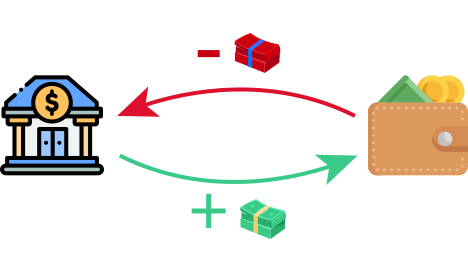
When you receive money from a bank or savings account, that value is positive, because you're gaining money.
When you send money to a bank, that value is negative, because you're losing money.
Inflation & Real Value
SL Core 1.4
The real interest rate (needed when a question involves inflation) is given by r%=c%−i%, where c% represents the given interest rate (the nominal rate) and i% represents the inflation rate.
Note: You can calculate the real interest rate r% and enter it directly into the TVM solver (when required) as the nominal annual interest rate (I% on your calculator), since the TVM solver does not account for inflation effects in its standard calculations.
Nice work completing Compounding (Appreciation & Depreciation), here's a quick recap of what we covered:
Skills covered
Exercises checked off
I'm Plex, here to help you understand this concept!