Topics

Testing for correlation ρ
0 of 0 exercises completed
Bivariate normal data and testing whether the population correlation coefficient ρ is zero using the sample correlation.
Want a deeper conceptual understanding? Try our interactive lesson!
Bivariate normal distribution
AHL AI 4.18
A bivariate normal distribution is a two dimension distribution of points (x,y) where the data clusters around center point and spreads out like a normal distribution in every direction.
Testing for population correlation: H₀ : ρ = 0 vs H₁ : ρ ≠ 0
AHL AI 4.18
We can test the significance of a correlation between two variables using a special kind of T-test.
To perform this test, it must be known or assumed that the data points (x,y) follow a bivariate normal distribution.
Enter the samples into L1 and L2
Navigate to LinRegTTest.
Select ρ=0,<0 or >0
The calculator returns the p-value (not to be confused with ρ), as well as the coefficients y=a+bx.
To understand what this does, consider the following two graphs:
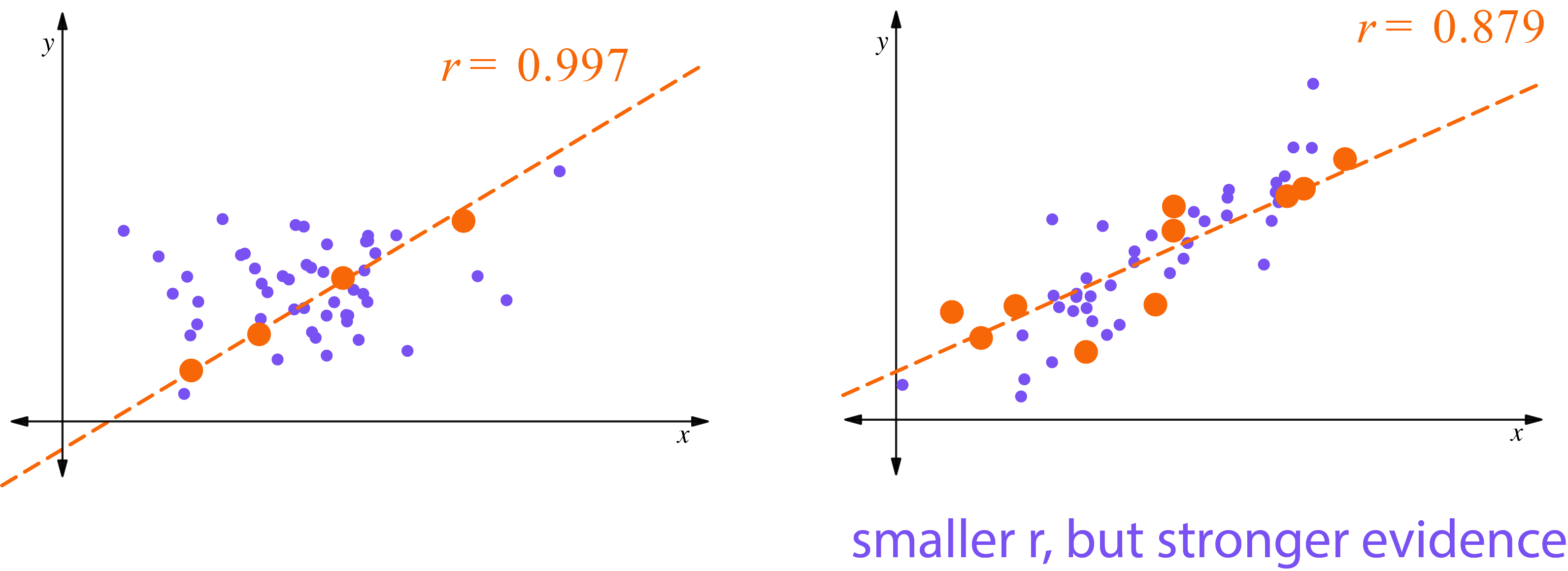
The graph on the left illustrates how a small sample of points can appear highly correlated even if the broader points are not. A larger sample of points showing a correlation is stronger evidence for the underlying correlation.
Nice work completing Testing for correlation ρ, here's a quick recap of what we covered:
Skills covered
Exercises checked off
I'm Plex, here to help you understand this concept!