Perplex
Dashboard
Topics
Exponents & LogarithmsApproximations & ErrorSequences & SeriesCounting & BinomialsProof and Reasoning
Cartesian plane & linesQuadraticsFunction TheoryTransformations & asymptotes
2D & 3D GeometryTrig equations & identities
ProbabilityDescriptive StatisticsBivariate StatisticsDistributions & Random Variables
DifferentiationIntegration
Review VideosFormula BookletMy Progress
BlogLanding Page
Sign UpLogin
Perplex
Perplex
Dashboard
Topics
Exponents & LogarithmsApproximations & ErrorSequences & SeriesCounting & BinomialsProof and Reasoning
Cartesian plane & linesQuadraticsFunction TheoryTransformations & asymptotes
2D & 3D GeometryTrig equations & identities
ProbabilityDescriptive StatisticsBivariate StatisticsDistributions & Random Variables
DifferentiationIntegration
Review VideosFormula BookletMy Progress
BlogLanding Page
Sign UpLogin
Perplex
IB Math AASL
/
Exponents & Logarithms
/
Skills
Edit

Skill Checklist

Track your progress across all skills in your objective. Mark your confidence level and identify areas to focus on.

Track your progress:

Don't know

Working on it

Confident

📖 = included in formula booklet • 🚫 = not in formula booklet

Track your progress:

Don't know

Working on it

Confident

📖 = included in formula booklet • 🚫 = not in formula booklet

IB Math AASL
/
Exponents & Logarithms
/
Skills
Edit

Skill Checklist

Track your progress across all skills in your objective. Mark your confidence level and identify areas to focus on.

Track your progress:

Don't know

Working on it

Confident

📖 = included in formula booklet • 🚫 = not in formula booklet

Track your progress:

Don't know

Working on it

Confident

📖 = included in formula booklet • 🚫 = not in formula booklet

Skill Checklist

Track your progress across all skills in your objective. Mark your confidence level and identify areas to focus on.

30 Skills Available

Track your progress:

Don't know

Working on it

Confident

📖 = included in formula booklet • 🚫 = not in formula booklet

Track your progress:

Don't know

Working on it

Confident

📖 = included in formula booklet • 🚫 = not in formula booklet

Exponential Algebra

8 skills
Exponential Notation
SL Core 1.5

Exponential expressions are a shortcut for writing the multiplication of a number by itself many times:

​
an=a×a×⋯×a​n times​🚫
​

Here ​a​ is called the base and ​n​ the exponent. We say that ​a​ is raised to the ​nth​ power.


Note that ​a1=a, since we have ​1×a=a.

Exponent with zero
SL Core 1.5

Any number raised to the power zero is

​
a0=1×a×a×⋯×a​0 times​=1🚫
​

And since any number multiplied by ​0​ is ​0:

​
0n=0,n=0🚫
​

When ​n=0, we have ​00, which is technically undefined, but in most contexts is defined to be

​
00=1🚫
​
Multiplying powers with the same base
SL Core 1.5

When multiplying exponentials with the same base, the following rule applies:


​
an⋅am    ​=a×a×⋯×a​n times​×a×a×⋯×a​m times​ =a×a×⋯×a​n+m times​ =am+n🚫​
​
Exponential of exponential
SL Core 1.5

An exponential can be the base of another exponential:

​
(am)n=a×⋯×a​m times​×⋯×a×⋯×a​m times​​n times​=anm🚫
​
Negative exponents
SL Core 1.5
​
a−n=an1​,a=0🚫
​
Dividing exponents with the same base
SL Core 1.5

In general,

​
aman​=an⋅a−m=an−m,a=0🚫
​
Exponents of products & quotients
SL Core 1.5

When exponentials with the same power are being multiplied or divided, the bases can be combined:

​
anbn=(ab)n🚫
​
​
bnan​=(ba​)n,b=0🚫
​
Exponential Equations (Equating Indices)
SL AA 1.7

If two exponentials in the same positive base are equal, their exponents must be equal:

​
an=am⇔n=m,a>0,a=1🚫
​


Exponentials can also appear in equations with one or more unknown:

​
(21​)x−1=8x+1
​
​
⇒(2−1)x−1=(23)x+1
​
​
⇒21−x=23x+3
​

Now we can equate the exponents:

​
1−x=3x+3⇒x=−21​
​

Radicals and Roots

7 skills
nth Roots
1. Prior learning

For any number ​a​ and positive integer ​n,

​
n√a
​

is called the ​n​th root of ​a.


The ​n​th root of ​a​ is the number that gives you ​a​ when raised to the ​n​th power:

​
(n√a)n=a
​

If ​n​ is even, then ​(n√a)n​ is necessarily positive, so we must restrict ​a>0.

Roots of negative numbers
SL Core 1.5

If ​a​ is negative, ​n√a​ is negative for all odd ​n.


For even ​n, no real ​n√a​ exists.

Converting nth roots to fractional exponents
SL AA 1.7

Roots can always be written as fractional exponents and vice versa:


​
n√a=an1​.
​
Rational exponents
SL AA 1.7

Utilizing ​n​th roots and exponential laws we can rewrite any rational exponent:

​
anm​=(an1​)m=n√am=(n√a)m
​
Simplest form radicals
SL AA 1.7

A radical is in simplest form if the integer under the radical sign is as small as possible.


For example, the simplest form of ​√48​ is ​4√3. We can simplify by splitting the radical into a reducible and irreducible part:


​
√48=√16⋅√3=4√3.
​
Simplest form fractions with radicals (multiplying by roots)
SL AA 1.7

A fraction in simplest form does not have a radical in the denominator.


For a fraction of the form ​√ba​​ where ​a∈Z,b∈N, we find the simplest form by mutliplying the numerator and denominator by ​√b:

​
√ba​=ba√b​.
​

When we remove a radical from a denominator, we call it rationalizing the denominator.

Rationalizing Denominators with Conjugates
SL AA 1.7

To simplify a fraction of the form ​b+√ca​,​ multiply the fraction by ​b−√cb−√c​.


​b−√c​ is called the conjugate of ​b+√c.

Logarithm algebra

9 skills
Definition of the logarithm
SL Core 1.5

Logarithms are a mathematical tool for asking "what power of a given base gives a specific value". We write this as

​
loga​b=x⇔ax=b.
​

Here, ​a​ is called the base, and it must be positive and not equal to ​1.  ​b​ must also be positive. The value of ​x, however, can be any real number.

Evaluating logs algebraically
SL AA 1.7

Some logarithms can be evaluated by hand using the fact that

​
loga​b=x⇒ax=b
​

For example, we can find ​log27​9​ by solving the equation

​
27x=9⇒33x=32⇒x=32​
​
Log base 10
SL Core 1.5

In science and mathematics, it is so common to use ​log10​​ that we can simply write the shorthand ​log​ to indicate ​log10​.


For example, ​log(0.001)=−3​ since ​10−3=0.001.

Natural logarithm
SL Core 1.5

Another special logarithm is the one in base ​e. We call it the natural logarithm due to the fundamental importance of ​e​ across mathematics.

​
loge​ is the same as ln
​


For example, ​ln(e3)=3.

Evaluating logs using technology
SL Core 1.5

If ​a​ and ​b​ are not powers of the same base, the log cannot be easily computed by hand. But we can use a calculator to evaluate them approximately.

​
log3​5≈1.46
​
Sum and difference of logs
SL AA 1.7

The sum of logs with the same base is the log of the products:

​
loga​x+loga​y=loga​(xy)📖
​


We have a similar rule for the difference of logs:

​
loga​x−loga​y=loga​(yx​)📖
​
Log power rule
SL AA 1.7
​
loga​(xm)=mloga​x📖
​
Log change of base
SL AA 1.7

We can change the base of a logarithm using the law

​
loga​x=logb​alogb​x​📖
​

for any choice of positive ​b=1.

Using logs to solve exponential equations
SL Core 1.5

Logarithms can be used to solve exponential equations:

​
ax=b⇔x=loga​b.
​

Exp & Log functions

6 skills
Exponential functions
SL AA 2.9

An exponential function has the form ​f(x)=ax​ for some base ​a>0​ (and ​a=1​). The domain of ​f​ is ​R, and the range is ​f(x)>0:

Graphing Exponential Functions
SL AA 2.9

In general, to graph an exponential function of the form ​f(x)=cax+k, find the ​y​-intercept of the curve, then analyze the behavior of the function on both ends (as ​x→∞​ and as ​x→−∞​). If possible, plotting other easily calculated points - often ​f(1)​ or ​f(−1).

  • The ​y​-intercept is at ​(0,c+k​) because ​f(0)=ca0+k=c(1)+k.

  • On one end, the curve will approach ​y=k.

    • For ​a<1, as ​x→∞,  ​f(x)→c(0)+k.​

    • For ​a>1, as ​x→−∞,  ​f(x)→c(0)+k.​

  • On the other end, the curve will rise with increasing steepness.

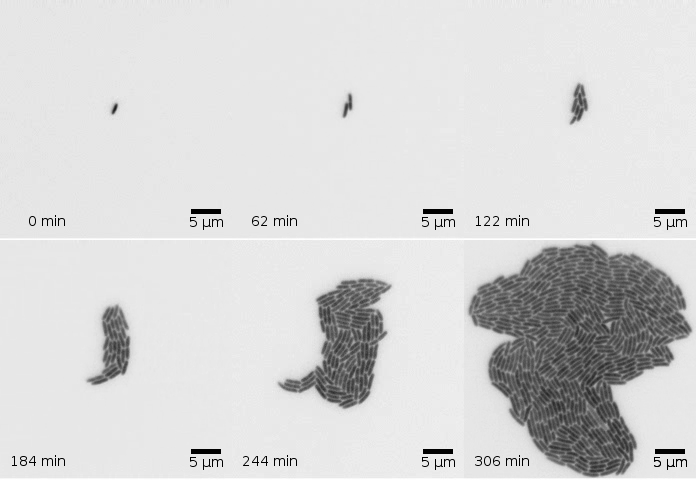
Exponential growth
SL AA 2.9

Exponential growth describes quantities that increase by the same factor over a certain amount of time. Algebraically, exponential growth is modeled by functions of the form

​
f(t)=Abt+c,
​

where ​b>1.  ​b​ is called the growth factor.


Note: ​Aekt​ is another model for exponential growth if the instantaneous growth rate, ​k, is positive.

problem image

Stewart EJ, Madden R, Paul G, Taddei F (2005), CC BY-SA 4.0

Exponential decay
SL AA 2.9

Exponential decay describes quantities that decrease by the same factor over a certain amount of time. Exponential decay is modeled by functions of the form

​
f(t)=Abt+c,
​

where ​0<b<1.  ​b​ is called the decay factor.


Note: ​Aekt​ is another model for exponential decay if the instantaneous growth rate, ​k, is negative.

Logarithmic functions
SL AA 2.9

A logarithmic function has the form ​f(x)=loga​x, for ​a>1. The domain of ​f​ is ​x>0, and the range is ​R:

Log and exponent functions are inverses
SL AA 2.9

The functions ​loga​x​ and ​ax​ are inverses:

​
loga​(ax)=x,aloga​x=x
​

This can be seen by the symmetry of their graphs in the line ​y=x:

Skill Checklist

Track your progress across all skills in your objective. Mark your confidence level and identify areas to focus on.

30 Skills Available

Track your progress:

Don't know

Working on it

Confident

📖 = included in formula booklet • 🚫 = not in formula booklet

Track your progress:

Don't know

Working on it

Confident

📖 = included in formula booklet • 🚫 = not in formula booklet

Exponential Algebra

8 skills
Exponential Notation
SL Core 1.5

Exponential expressions are a shortcut for writing the multiplication of a number by itself many times:

​
an=a×a×⋯×a​n times​🚫
​

Here ​a​ is called the base and ​n​ the exponent. We say that ​a​ is raised to the ​nth​ power.


Note that ​a1=a, since we have ​1×a=a.

Exponent with zero
SL Core 1.5

Any number raised to the power zero is

​
a0=1×a×a×⋯×a​0 times​=1🚫
​

And since any number multiplied by ​0​ is ​0:

​
0n=0,n=0🚫
​

When ​n=0, we have ​00, which is technically undefined, but in most contexts is defined to be

​
00=1🚫
​
Multiplying powers with the same base
SL Core 1.5

When multiplying exponentials with the same base, the following rule applies:


​
an⋅am    ​=a×a×⋯×a​n times​×a×a×⋯×a​m times​ =a×a×⋯×a​n+m times​ =am+n🚫​
​
Exponential of exponential
SL Core 1.5

An exponential can be the base of another exponential:

​
(am)n=a×⋯×a​m times​×⋯×a×⋯×a​m times​​n times​=anm🚫
​
Negative exponents
SL Core 1.5
​
a−n=an1​,a=0🚫
​
Dividing exponents with the same base
SL Core 1.5

In general,

​
aman​=an⋅a−m=an−m,a=0🚫
​
Exponents of products & quotients
SL Core 1.5

When exponentials with the same power are being multiplied or divided, the bases can be combined:

​
anbn=(ab)n🚫
​
​
bnan​=(ba​)n,b=0🚫
​
Exponential Equations (Equating Indices)
SL AA 1.7

If two exponentials in the same positive base are equal, their exponents must be equal:

​
an=am⇔n=m,a>0,a=1🚫
​


Exponentials can also appear in equations with one or more unknown:

​
(21​)x−1=8x+1
​
​
⇒(2−1)x−1=(23)x+1
​
​
⇒21−x=23x+3
​

Now we can equate the exponents:

​
1−x=3x+3⇒x=−21​
​

Radicals and Roots

7 skills
nth Roots
1. Prior learning

For any number ​a​ and positive integer ​n,

​
n√a
​

is called the ​n​th root of ​a.


The ​n​th root of ​a​ is the number that gives you ​a​ when raised to the ​n​th power:

​
(n√a)n=a
​

If ​n​ is even, then ​(n√a)n​ is necessarily positive, so we must restrict ​a>0.

Roots of negative numbers
SL Core 1.5

If ​a​ is negative, ​n√a​ is negative for all odd ​n.


For even ​n, no real ​n√a​ exists.

Converting nth roots to fractional exponents
SL AA 1.7

Roots can always be written as fractional exponents and vice versa:


​
n√a=an1​.
​
Rational exponents
SL AA 1.7

Utilizing ​n​th roots and exponential laws we can rewrite any rational exponent:

​
anm​=(an1​)m=n√am=(n√a)m
​
Simplest form radicals
SL AA 1.7

A radical is in simplest form if the integer under the radical sign is as small as possible.


For example, the simplest form of ​√48​ is ​4√3. We can simplify by splitting the radical into a reducible and irreducible part:


​
√48=√16⋅√3=4√3.
​
Simplest form fractions with radicals (multiplying by roots)
SL AA 1.7

A fraction in simplest form does not have a radical in the denominator.


For a fraction of the form ​√ba​​ where ​a∈Z,b∈N, we find the simplest form by mutliplying the numerator and denominator by ​√b:

​
√ba​=ba√b​.
​

When we remove a radical from a denominator, we call it rationalizing the denominator.

Rationalizing Denominators with Conjugates
SL AA 1.7

To simplify a fraction of the form ​b+√ca​,​ multiply the fraction by ​b−√cb−√c​.


​b−√c​ is called the conjugate of ​b+√c.

Logarithm algebra

9 skills
Definition of the logarithm
SL Core 1.5

Logarithms are a mathematical tool for asking "what power of a given base gives a specific value". We write this as

​
loga​b=x⇔ax=b.
​

Here, ​a​ is called the base, and it must be positive and not equal to ​1.  ​b​ must also be positive. The value of ​x, however, can be any real number.

Evaluating logs algebraically
SL AA 1.7

Some logarithms can be evaluated by hand using the fact that

​
loga​b=x⇒ax=b
​

For example, we can find ​log27​9​ by solving the equation

​
27x=9⇒33x=32⇒x=32​
​
Log base 10
SL Core 1.5

In science and mathematics, it is so common to use ​log10​​ that we can simply write the shorthand ​log​ to indicate ​log10​.


For example, ​log(0.001)=−3​ since ​10−3=0.001.

Natural logarithm
SL Core 1.5

Another special logarithm is the one in base ​e. We call it the natural logarithm due to the fundamental importance of ​e​ across mathematics.

​
loge​ is the same as ln
​


For example, ​ln(e3)=3.

Evaluating logs using technology
SL Core 1.5

If ​a​ and ​b​ are not powers of the same base, the log cannot be easily computed by hand. But we can use a calculator to evaluate them approximately.

​
log3​5≈1.46
​
Sum and difference of logs
SL AA 1.7

The sum of logs with the same base is the log of the products:

​
loga​x+loga​y=loga​(xy)📖
​


We have a similar rule for the difference of logs:

​
loga​x−loga​y=loga​(yx​)📖
​
Log power rule
SL AA 1.7
​
loga​(xm)=mloga​x📖
​
Log change of base
SL AA 1.7

We can change the base of a logarithm using the law

​
loga​x=logb​alogb​x​📖
​

for any choice of positive ​b=1.

Using logs to solve exponential equations
SL Core 1.5

Logarithms can be used to solve exponential equations:

​
ax=b⇔x=loga​b.
​

Exp & Log functions

6 skills
Exponential functions
SL AA 2.9

An exponential function has the form ​f(x)=ax​ for some base ​a>0​ (and ​a=1​). The domain of ​f​ is ​R, and the range is ​f(x)>0:

Graphing Exponential Functions
SL AA 2.9

In general, to graph an exponential function of the form ​f(x)=cax+k, find the ​y​-intercept of the curve, then analyze the behavior of the function on both ends (as ​x→∞​ and as ​x→−∞​). If possible, plotting other easily calculated points - often ​f(1)​ or ​f(−1).

  • The ​y​-intercept is at ​(0,c+k​) because ​f(0)=ca0+k=c(1)+k.

  • On one end, the curve will approach ​y=k.

    • For ​a<1, as ​x→∞,  ​f(x)→c(0)+k.​

    • For ​a>1, as ​x→−∞,  ​f(x)→c(0)+k.​

  • On the other end, the curve will rise with increasing steepness.

Exponential growth
SL AA 2.9

Exponential growth describes quantities that increase by the same factor over a certain amount of time. Algebraically, exponential growth is modeled by functions of the form

​
f(t)=Abt+c,
​

where ​b>1.  ​b​ is called the growth factor.


Note: ​Aekt​ is another model for exponential growth if the instantaneous growth rate, ​k, is positive.

problem image

Stewart EJ, Madden R, Paul G, Taddei F (2005), CC BY-SA 4.0

Exponential decay
SL AA 2.9

Exponential decay describes quantities that decrease by the same factor over a certain amount of time. Exponential decay is modeled by functions of the form

​
f(t)=Abt+c,
​

where ​0<b<1.  ​b​ is called the decay factor.


Note: ​Aekt​ is another model for exponential decay if the instantaneous growth rate, ​k, is negative.

Logarithmic functions
SL AA 2.9

A logarithmic function has the form ​f(x)=loga​x, for ​a>1. The domain of ​f​ is ​x>0, and the range is ​R:

Log and exponent functions are inverses
SL AA 2.9

The functions ​loga​x​ and ​ax​ are inverses:

​
loga​(ax)=x,aloga​x=x
​

This can be seen by the symmetry of their graphs in the line ​y=x: