Topics

Exp & Log functions
0 of 0 exercises completed
Exponential functions f(x)=ax and logarithmic functions f(x)=logax,
Exponential functions
SL AA 2.9
An exponential function has the form f(x)=ax for some base a>0 (and a=1). The domain of f is R, and the range is f(x)>0:
Graphing Exponential Functions
SL AA 2.9
In general, to graph an exponential function of the form f(x)=cax+k, find the y-intercept of the curve, then analyze the behavior of the function on both ends (as x→∞ and as x→−∞). If possible, plotting other easily calculated points - often f(1) or f(−1).
The y-intercept is at (0,c+k) because f(0)=ca0+k=c(1)+k.
On one end, the curve will approach y=k.
For a<1, as x→∞, f(x)→c(0)+k.
For a>1, as x→−∞, f(x)→c(0)+k.
On the other end, the curve will rise with increasing steepness.
Exponential growth
SL AA 2.9
Exponential growth describes quantities that increase by the same factor over a certain amount of time. Algebraically, exponential growth is modeled by functions of the form
f(t)=Abt+c,
where b>1. b is called the growth factor.
Note: Aekt is another model for exponential growth if the instantaneous growth rate, k, is positive.
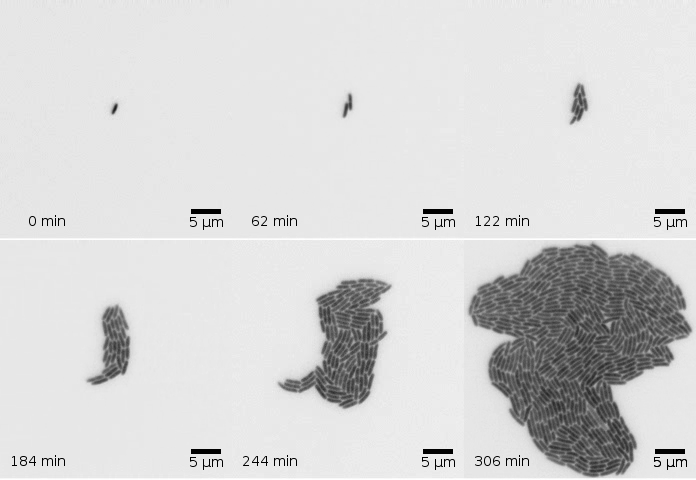
Stewart EJ, Madden R, Paul G, Taddei F (2005), CC BY-SA 4.0
Exponential decay
SL AA 2.9
Exponential decay describes quantities that decrease by the same factor over a certain amount of time. Exponential decay is modeled by functions of the form
f(t)=Abt+c,
where 0<b<1. b is called the decay factor.
Note: Aekt is another model for exponential decay if the instantaneous growth rate, k, is negative.
Logarithmic functions
SL AA 2.9
A logarithmic function has the form f(x)=logax, for a>1. The domain of f is x>0, and the range is R:
Log and exponent functions are inverse functions
SL AA 2.9
The functions logax and ax are inverses:
loga(ax)=x,alogax=x
This can be seen by the symmetry of their graphs in the line y=x:
Nice work completing Exp & Log functions, here's a quick recap of what we covered:
Skills covered
Exercises checked off
I'm Plex, here to help you understand this concept!