Perplex
Content
  • Exponents & Logarithms
  • Approximations & Error
  • Sequences & Series
  • Counting & Binomials
  • Proof and Reasoning
  • Cartesian plane & lines
  • Quadratics
  • Function Theory
  • Transformations & asymptotes
  • 2D & 3D Geometry
  • Trig equations & identities
  • Probability
  • Descriptive Statistics
  • Bivariate Statistics
  • Distributions & Random Variables
  • Differentiation
  • Integration
Other
  • Review Videos
  • Blog
  • Landing Page
  • Sign Up
  • Login
  • Perplex
    IB Math AASL
    /
    Counting & Binomials
    /

    Skills

    Edit

    Skill Checklist

    Track your progress across all skills in your objective. Mark your confidence level and identify areas to focus on.

    Track your progress:

    Don't know

    Working on it

    Confident

    📖 = included in formula booklet • 🚫 = not in formula booklet

    Track your progress:

    Don't know

    Working on it

    Confident

    📖 = included in formula booklet • 🚫 = not in formula booklet

    Skill Checklist

    Track your progress across all skills in your objective. Mark your confidence level and identify areas to focus on.

    5 Skills Available

    Track your progress:

    Don't know

    Working on it

    Confident

    📖 = included in formula booklet • 🚫 = not in formula booklet

    Track your progress:

    Don't know

    Working on it

    Confident

    📖 = included in formula booklet • 🚫 = not in formula booklet

    Pascal's Triangle and nCr

    4 skills
    Factorials
    SL AA 1.9

    Factorials are shortcut used to express decreasing products of integers such as

    5⋅4⋅3⋅2⋅1=5!

    The definition is

    n!=n×(n−1)×⋯×2×1🚫
    Fractions of factorials as partial products
    SL AA 1.9
    k!n!​=n×(n−1)×⋯×(k+2)×(k+1)
    Binomial Coefficient nCr
    SL AA 1.9

    The number of ways to choose r items from a set of n items can be expressed as (nr​), n​Cr​ or nCr​. The number of combinations can be calculated using the formula

    nCr​=r!(n−r)!n!​📖
    Pascal's Triangle
    SL AA 1.9

    Pascal's triangle is a triangular array where each number is the sum of the two directly above it, beautifully revealing the coefficients of binomial expansions. Each term corresponds to a specific value of nCr​. Its symmetry and simple construction make it a powerful tool for exploring combinatorial relationships and probability.

    Powered by Desmos
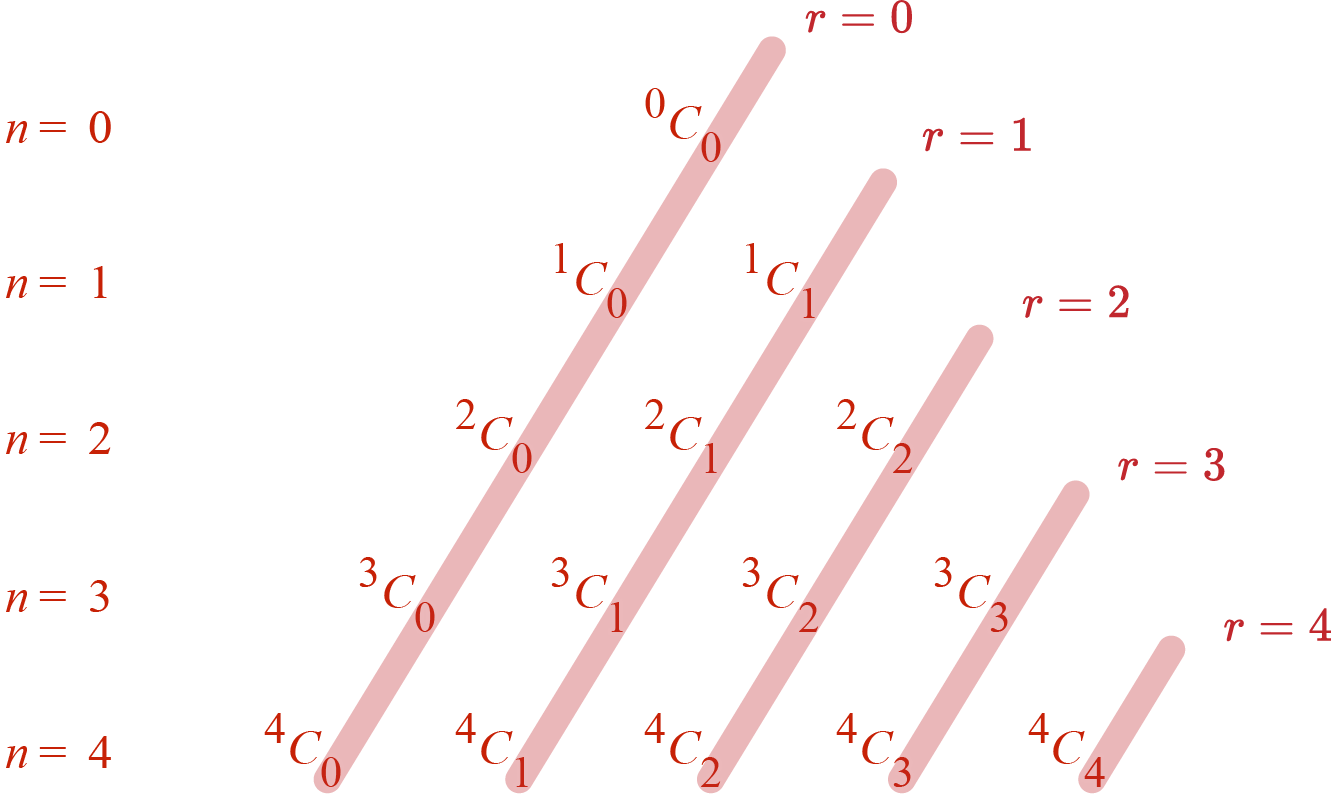

    <p>The figure shows the first five rows (n = 0 through n = 4) of Pascal’s triangle arranged into diagonal “strips,” each strip corresponding to a fixed r-value (r = 0 through r = 4).</p>
<p>• Along the left margin are the row labels “n = 0,” “n = 1,” “n = 2,” “n = 3,” and “n = 4,” stacked vertically.<br>
• Along the top (above each diagonal strip) are the column labels “r = 0,” “r = 1,” “r = 2,” “r = 3,” and “r = 4,” laid out from left to right.<br>
• Each strip is drawn as a thick, slanted red bar rising from lower left to upper right.<br>
• On each strip, at the positions where that strip intersects the rows n = 0…4, is printed the corresponding binomial coefficient in the form “ⁿCᵣ” inside a small white circle outlined in red. For example:<br>
– On the r = 0 strip are ⁰C₀, ¹C₀, ²C₀, ³C₀, and ⁴C₀.<br>
– On the r = 1 strip are ¹C₁, ²C₁, ³C₁, and ⁴C₁.<br>
– On the r = 2 strip are ²C₂, ³C₂, and ⁴C₂.<br>
– On the r = 3 strip are ³C₃ and ⁴C₃.<br>
– On the r = 4 strip is ⁴C₄ alone.</p>
<p>No numerical values of the coefficients are shown—only their symbolic form.</p>


    Binomial Theorem

    1 skill
    The expansion of (a+b)ⁿ
    SL AA 1.9

    The binomial theorem allows us expand expressions of the form (a+b)n:

    (a+b)n=an+nC1​an−1b1+nC2​an−2b2+⋯📖

    or in summation form:

    (a+b)n=r=0∑n​(nr​)an−rbr🚫