Topics

Volumes of Revolution
0 of 0 exercises completed
Finding the volume of a solid revolved around a function or axis to create a 3D figure
Want a deeper conceptual understanding? Try our interactive lesson! (Plus Only)
The volume produced by a 3D shape which is symmetrical around the x-axis can be approximated by slicing it up into tiny cylinders, and adding them up.
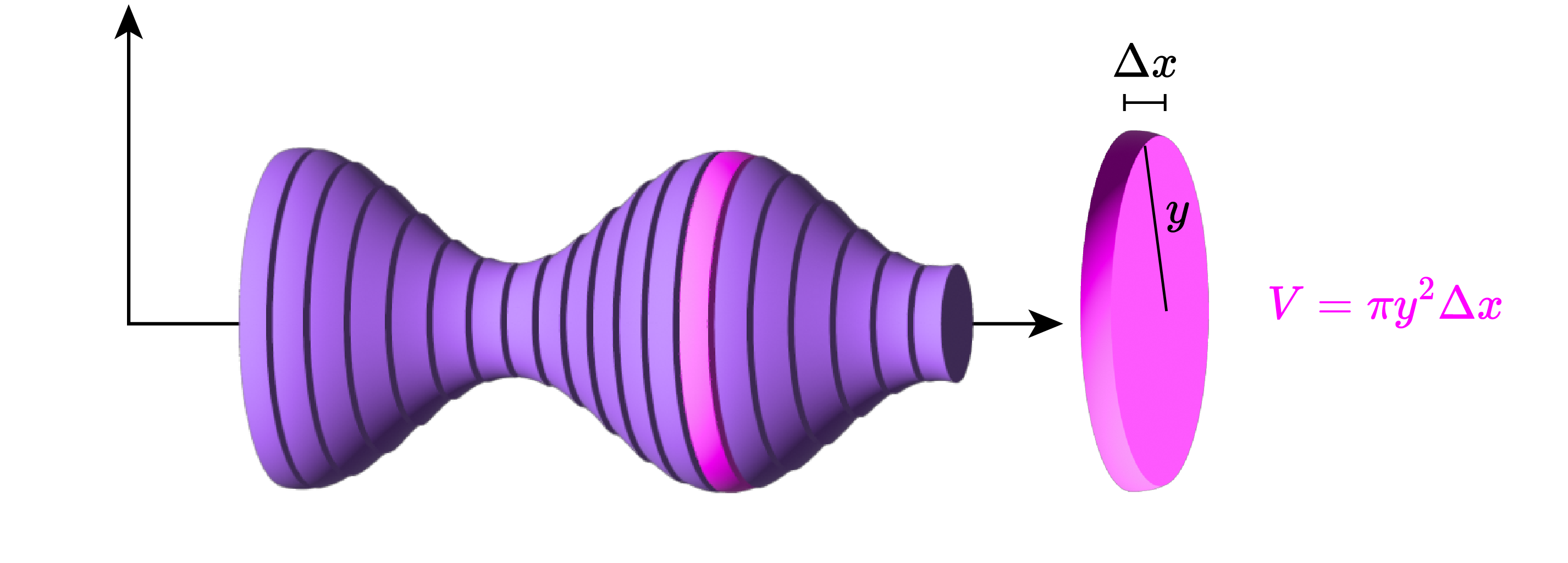
We can make this approximation exact by making the cylinder infinitely small and integrating.
Volume of revolution about x-axis
AHL 5.16
A curve y=f(x) can be revolved around the x-axis to produce a 3D solid. The following example shows y=2+sinx revolved 2π about the x-axis.
The volume of the resulting solid is given by
V=∫abπy2dx📖
Volume of revolution about y-axis
AHL 5.16
The volume of the solid produced by revolving a curve 2π about the y-axis by finding x in terms of y and evaluating
V=∫abπx2dy📖
Nice work completing Volumes of Revolution, here's a quick recap of what we covered:
Skills covered
Exercises checked off
I'm Plex, here to help you understand this concept!