Perplex
Dashboard
Topics
Exponents & LogarithmsRounding & ErrorSequences & SeriesCounting & BinomialsProof and ReasoningComplex NumbersAlgebra Skills
Cartesian plane & linesQuadraticsFunction TheoryTransformations & asymptotesPolynomials
2D & 3D GeometryTrig equations & identitiesVectors
ProbabilityDescriptive StatisticsBivariate StatisticsDistributions & Random Variables
DifferentiationIntegrationDifferential EquationsMaclaurin
Review VideosFormula BookletMy Progress
BlogLanding Page
Sign UpLogin
Perplex
Perplex
Dashboard
Topics
Exponents & LogarithmsRounding & ErrorSequences & SeriesCounting & BinomialsProof and ReasoningComplex NumbersAlgebra Skills
Cartesian plane & linesQuadraticsFunction TheoryTransformations & asymptotesPolynomials
2D & 3D GeometryTrig equations & identitiesVectors
ProbabilityDescriptive StatisticsBivariate StatisticsDistributions & Random Variables
DifferentiationIntegrationDifferential EquationsMaclaurin
Review VideosFormula BookletMy Progress
BlogLanding Page
Sign UpLogin
Perplex
/
Function Theory
/
Function Composition
Even and odd functions
Function Composition
Function Theory

Function Composition

0 of 0 exercises completed

Composing functions like ​f∘g​

Want a deeper conceptual understanding? Try our interactive lesson! (Plus Only)

Composite functions
SL AA 2.5

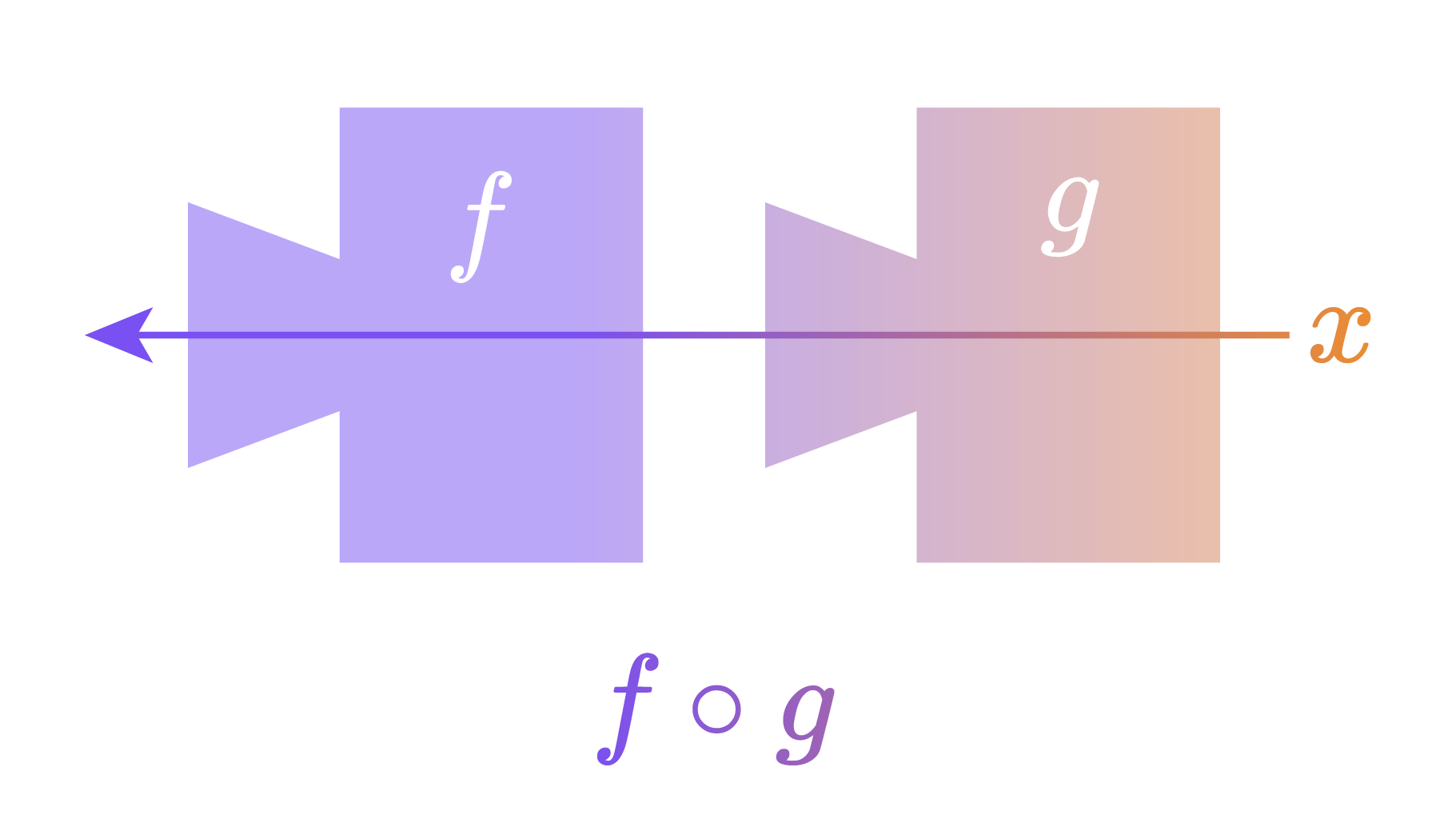
Functions can be composed by passing the output of one into the other. We use the symbol ​∘, and pay close attention to the order in which functions are composed:

​
(f∘g)(x)=f(g(x))🚫
​

To find an expression for ​f(g(x)), substitute ​g(x)​ for ​x​ in the expression for ​f(x).


Notice that for ​(f∘g)(x), we first pass ​x​ into ​g, and then pass that output into ​f.

problem image

Nice work completing Function Composition, here's a quick recap of what we covered:

Skills covered

Mixed Practice

Exercises checked off

I'm Plex, here to help you understand this concept!
/
Function Theory
/
Function Composition
Even and odd functions
Function Composition
Function Theory

Function Composition

0 of 0 exercises completed

Composing functions like ​f∘g​

Want a deeper conceptual understanding? Try our interactive lesson! (Plus Only)

Composite functions
SL AA 2.5

Functions can be composed by passing the output of one into the other. We use the symbol ​∘, and pay close attention to the order in which functions are composed:

​
(f∘g)(x)=f(g(x))🚫
​

To find an expression for ​f(g(x)), substitute ​g(x)​ for ​x​ in the expression for ​f(x).


Notice that for ​(f∘g)(x), we first pass ​x​ into ​g, and then pass that output into ​f.

problem image

Nice work completing Function Composition, here's a quick recap of what we covered:

Skills covered

Mixed Practice

Exercises checked off

I'm Plex, here to help you understand this concept!

Generating starter questions...

1 free

Generating starter questions...

1 free