Perplex
Dashboard
Topics
Exponents & LogarithmsRounding & ErrorSequences & SeriesCounting & BinomialsProof and ReasoningComplex NumbersAlgebra Skills
Cartesian plane & linesQuadraticsFunction TheoryTransformations & asymptotesPolynomials
2D & 3D GeometryTrig equations & identitiesVectors
ProbabilityDescriptive StatisticsBivariate StatisticsDistributions & Random Variables
DifferentiationIntegrationDifferential EquationsMaclaurin
Review VideosFormula BookletMy Progress
BlogLanding Page
Sign UpLogin
Perplex
Perplex
Dashboard
Topics
Exponents & LogarithmsRounding & ErrorSequences & SeriesCounting & BinomialsProof and ReasoningComplex NumbersAlgebra Skills
Cartesian plane & linesQuadraticsFunction TheoryTransformations & asymptotesPolynomials
2D & 3D GeometryTrig equations & identitiesVectors
ProbabilityDescriptive StatisticsBivariate StatisticsDistributions & Random Variables
DifferentiationIntegrationDifferential EquationsMaclaurin
Review VideosFormula BookletMy Progress
BlogLanding Page
Sign UpLogin
Perplex
/
Counting & Binomials
/
Pascal's Triangle and nCr
Binomial Theorem
Pascal's Triangle and nCr
Counting & Binomials

Pascal's Triangle and nCr

0 of 0 exercises completed
Pascal's triangle and binomial coefficients, using factorials and \(^{n}C_{r}=\frac{n!}{r!(n-r)!}\) to find combinations and the coefficients in binomial expansions.

Want a deeper conceptual understanding? Try our interactive lesson!

Factorials
SL AA 1.9

Factorials are shortcut used to express decreasing products of integers such as

​
5⋅4⋅3⋅2⋅1=5!
​

The definition is

​
n!=n×(n−1)×⋯×2×1🚫
​
Fractions of factorials as partial products
SL AA 1.9
​
k!n!​=n×(n−1)×⋯×(k+2)×(k+1)
​
Binomial Coefficient nCr
SL AA 1.9

The number of ways to choose ​r​ items from a set of ​n​ items can be expressed as ​(nr​),  ​n​Cr​​ or ​nCr​. The number of combinations can be calculated using the formula

​
nCr​=r!(n−r)!n!​📖
​
Pascal's Triangle
SL AA 1.9

Pascal's triangle is a triangular array where each number is the sum of the two directly above it, beautifully revealing the coefficients of binomial expansions. Each term corresponds to a specific value of ​nCr​. Its symmetry and simple construction make it a powerful tool for exploring combinatorial relationships and probability.
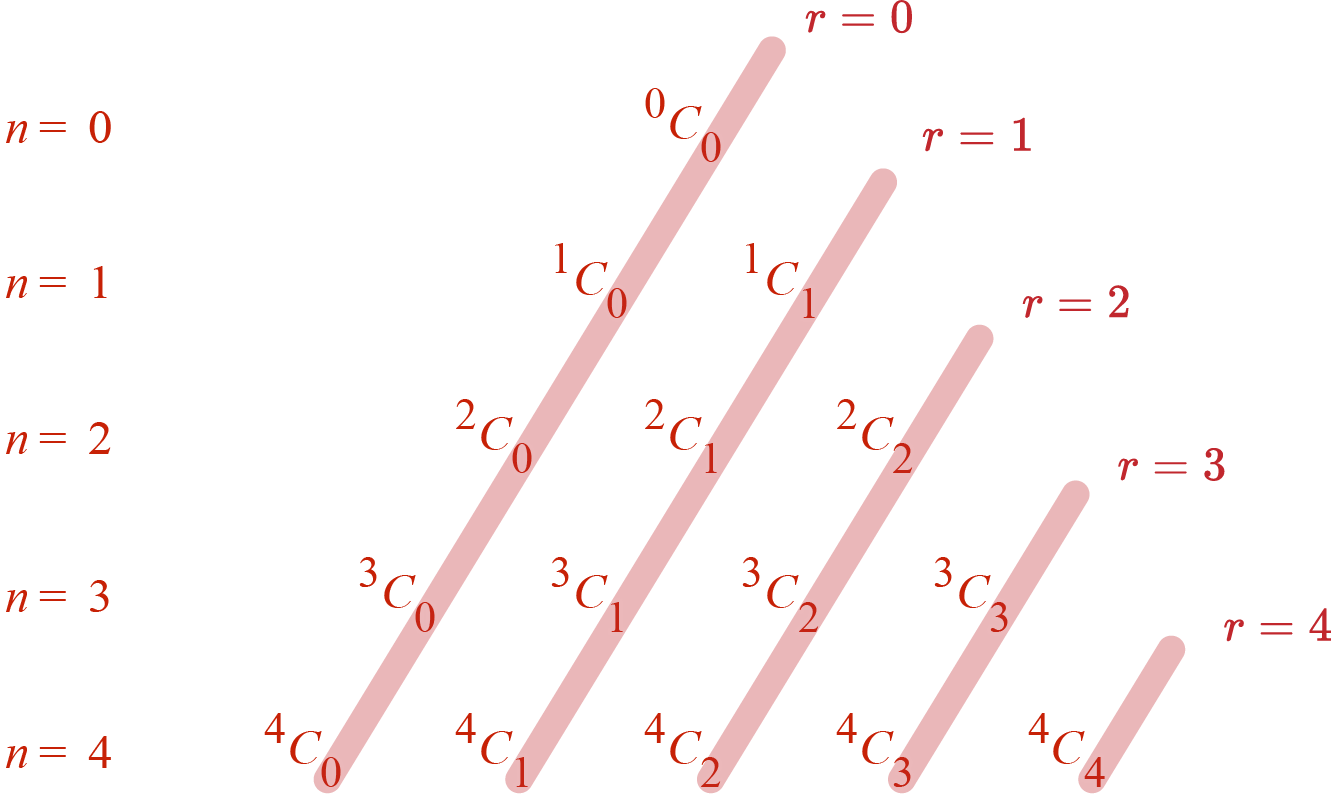

<p>The figure shows the first five rows (n = 0 through n = 4) of Pascal’s triangle arranged into diagonal “strips,” each strip corresponding to a fixed r-value (r = 0 through r = 4).</p>
<p>• Along the left margin are the row labels “n = 0,” “n = 1,” “n = 2,” “n = 3,” and “n = 4,” stacked vertically.<br>
• Along the top (above each diagonal strip) are the column labels “r = 0,” “r = 1,” “r = 2,” “r = 3,” and “r = 4,” laid out from left to right.<br>
• Each strip is drawn as a thick, slanted red bar rising from lower left to upper right.<br>
• On each strip, at the positions where that strip intersects the rows n = 0…4, is printed the corresponding binomial coefficient in the form “ⁿCᵣ” inside a small white circle outlined in red. For example:<br>
– On the r = 0 strip are ⁰C₀, ¹C₀, ²C₀, ³C₀, and ⁴C₀.<br>
– On the r = 1 strip are ¹C₁, ²C₁, ³C₁, and ⁴C₁.<br>
– On the r = 2 strip are ²C₂, ³C₂, and ⁴C₂.<br>
– On the r = 3 strip are ³C₃ and ⁴C₃.<br>
– On the r = 4 strip is ⁴C₄ alone.</p>
<p>No numerical values of the coefficients are shown—only their symbolic form.</p>


Nice work completing Pascal's Triangle and nCr, here's a quick recap of what we covered:

Skills covered

Mixed Practice

Exercises checked off

I'm Plex, here to help you understand this concept!
/
Counting & Binomials
/
Pascal's Triangle and nCr
Binomial Theorem
Pascal's Triangle and nCr
Counting & Binomials

Pascal's Triangle and nCr

0 of 0 exercises completed
Pascal's triangle and binomial coefficients, using factorials and \(^{n}C_{r}=\frac{n!}{r!(n-r)!}\) to find combinations and the coefficients in binomial expansions.

Want a deeper conceptual understanding? Try our interactive lesson!

Factorials
SL AA 1.9

Factorials are shortcut used to express decreasing products of integers such as

​
5⋅4⋅3⋅2⋅1=5!
​

The definition is

​
n!=n×(n−1)×⋯×2×1🚫
​
Fractions of factorials as partial products
SL AA 1.9
​
k!n!​=n×(n−1)×⋯×(k+2)×(k+1)
​
Binomial Coefficient nCr
SL AA 1.9

The number of ways to choose ​r​ items from a set of ​n​ items can be expressed as ​(nr​),  ​n​Cr​​ or ​nCr​. The number of combinations can be calculated using the formula

​
nCr​=r!(n−r)!n!​📖
​
Pascal's Triangle
SL AA 1.9

Pascal's triangle is a triangular array where each number is the sum of the two directly above it, beautifully revealing the coefficients of binomial expansions. Each term corresponds to a specific value of ​nCr​. Its symmetry and simple construction make it a powerful tool for exploring combinatorial relationships and probability.


<p>The figure shows the first five rows (n = 0 through n = 4) of Pascal’s triangle arranged into diagonal “strips,” each strip corresponding to a fixed r-value (r = 0 through r = 4).</p>
<p>• Along the left margin are the row labels “n = 0,” “n = 1,” “n = 2,” “n = 3,” and “n = 4,” stacked vertically.<br>
• Along the top (above each diagonal strip) are the column labels “r = 0,” “r = 1,” “r = 2,” “r = 3,” and “r = 4,” laid out from left to right.<br>
• Each strip is drawn as a thick, slanted red bar rising from lower left to upper right.<br>
• On each strip, at the positions where that strip intersects the rows n = 0…4, is printed the corresponding binomial coefficient in the form “ⁿCᵣ” inside a small white circle outlined in red. For example:<br>
– On the r = 0 strip are ⁰C₀, ¹C₀, ²C₀, ³C₀, and ⁴C₀.<br>
– On the r = 1 strip are ¹C₁, ²C₁, ³C₁, and ⁴C₁.<br>
– On the r = 2 strip are ²C₂, ³C₂, and ⁴C₂.<br>
– On the r = 3 strip are ³C₃ and ⁴C₃.<br>
– On the r = 4 strip is ⁴C₄ alone.</p>
<p>No numerical values of the coefficients are shown—only their symbolic form.</p>


Nice work completing Pascal's Triangle and nCr, here's a quick recap of what we covered:

Skills covered

Mixed Practice

Exercises checked off

I'm Plex, here to help you understand this concept!

Generating starter questions...

1 free

Generating starter questions...

1 free