Perplex
Dashboard
Topics
Exponents & LogarithmsRounding & ErrorSequences & SeriesCounting & BinomialsProof and ReasoningComplex NumbersAlgebra Skills
Cartesian plane & linesQuadraticsFunction TheoryTransformations & asymptotesPolynomials
2D & 3D GeometryTrig equations & identitiesVectors
ProbabilityDescriptive StatisticsBivariate StatisticsDistributions & Random Variables
DifferentiationIntegrationDifferential EquationsMaclaurin
Review VideosFormula BookletMy Progress
BlogLanding Page
Sign UpLogin
Perplex
Perplex
Dashboard
Topics
Exponents & LogarithmsRounding & ErrorSequences & SeriesCounting & BinomialsProof and ReasoningComplex NumbersAlgebra Skills
Cartesian plane & linesQuadraticsFunction TheoryTransformations & asymptotesPolynomials
2D & 3D GeometryTrig equations & identitiesVectors
ProbabilityDescriptive StatisticsBivariate StatisticsDistributions & Random Variables
DifferentiationIntegrationDifferential EquationsMaclaurin
Review VideosFormula BookletMy Progress
BlogLanding Page
Sign UpLogin
Perplex
/
2D & 3D Geometry
/
3D space & solids
Applied triangle geometry
3D space & solids
2D & 3D Geometry

3D space & solids

0 of 0 exercises completed

Spheres, cylinders, prisms, right cones, right pyramids, and combinations of solids

Want a deeper conceptual understanding? Try our interactive lesson! (Plus Only)

3D coordinates
SL Core 3.1

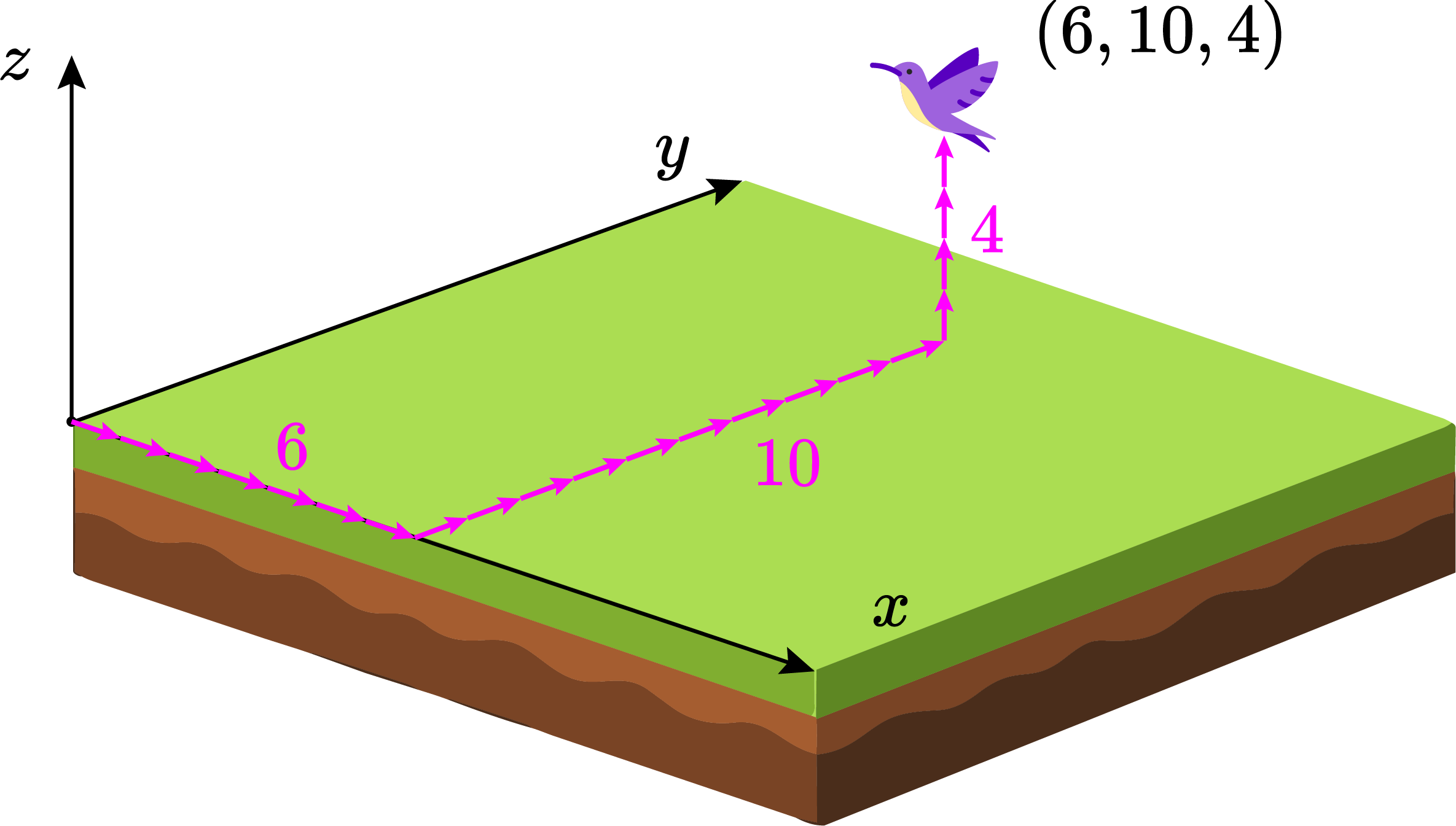
The familiar cartesian plane with ​(x,y)​ coordinates can be extended to 3D space by introducing a ​z​ coordinate, making a 3D coordinate have the form ​(x,y,z). Each component (​x,y​ and ​z​) tells you how many unit "steps" to take from the origin in the direction of each axis to reach the described point.
problem image
Angles in 3D
SL Core 3.1

By carefully imagining right triangles in 3D diagrams, we can find angles in space.

In the triangular prism below, we can find the length ​CB​ using Pythagoras. Then, since there is a right angle at ​C, we can write

​
tanθ=4√29​⇒θ≈53.4∘
​
Spheres
SL Core 3.1

A sphere is a perfectly round, three-dimensional geometric shape where every point on its surface is exactly the same distance (the radius) from a single central point. It's the three-dimensional analog of a circle. For example, a ball or globe is spherical in shape. The surface area ​A​ and volume ​V​ of a sphere are given by:

​
AV​=4πr2=34​πr3​
​


Cylinders
3. Prior learning

A cylinder is a three-dimensional geometric shape formed by two identical circular bases connected by a curved lateral surface. The segment connecting the centers of the circular bases is called the axis, which is perpendicular to each base in a right cylinder (the type usually studied).

The volume ​V​ of a cylinder with radius ​r​ is given by:

​
V=πr2h📖
​


The curved surface of a cylinder (excluding the circular ends) is given by:

​
A=2πrh📖
​

If we include the circular ends, each with area ​πr2, we get

​
A=2πr(r+h)🚫
​
Volume of a prism
3. Prior learning

A prism is a three-dimensional solid shape consisting of two parallel, congruent faces called bases, connected by rectangular lateral faces. Prisms are named according to the shape of their bases—for example, triangular prism, rectangular prism, or hexagonal prism.

The volume ​V​ of a prism is calculated by multiplying the area ​A​ of its base by its height ​h:

​
V=Ah
​


Right cones
SL Core 3.1

A right circular cone is a three-dimensional geometric shape whose apex (vertex) lies directly above the center of its circular base.

Key Parts:

  • Circular Base: Flat circle with radius ​r.

  • Apex (Vertex): The point directly above the center of the base.

  • Height (​h​): Perpendicular distance from apex to base center.

  • Slant Height (​l​): Distance along the cone's surface from apex to edge of base.

Formulas:

  • Volume:

​
V=31​πr2h📖
​
  • Surface Area of curved surface:

​
A=πrl📖
​
  • Slant Height Relationship:

​
l=√r2+h2​🚫
​


Right Pyramid
SL Core 3.1

A right pyramid is a three-dimensional shape with a polygonal base and triangular lateral faces, in which the apex (vertex) is located directly above the center (centroid) of the base.

Key Parts:

  • Polygonal base: a flat polygon (triangle, square, pentagon, etc.)

  • Apex (vertex): the point positioned vertically above the base's centroid

  • Height (​h​): perpendicular distance from apex to base centroid

  • Slant height (​l​): distance along a lateral face from the apex perpendicular to an edge of the base

The volume of a right pyramid is given by

​
V=31​A×h
​

where ​A​ is the area of the base.


Nice work completing 3D space & solids, here's a quick recap of what we covered:

Skills covered

Mixed Practice

Exercises checked off

I'm Plex, here to help you understand this concept!
/
2D & 3D Geometry
/
3D space & solids
Applied triangle geometry
3D space & solids
2D & 3D Geometry

3D space & solids

0 of 0 exercises completed

Spheres, cylinders, prisms, right cones, right pyramids, and combinations of solids

Want a deeper conceptual understanding? Try our interactive lesson! (Plus Only)

3D coordinates
SL Core 3.1

The familiar cartesian plane with ​(x,y)​ coordinates can be extended to 3D space by introducing a ​z​ coordinate, making a 3D coordinate have the form ​(x,y,z). Each component (​x,y​ and ​z​) tells you how many unit "steps" to take from the origin in the direction of each axis to reach the described point.

problem image
Angles in 3D
SL Core 3.1

By carefully imagining right triangles in 3D diagrams, we can find angles in space.

In the triangular prism below, we can find the length ​CB​ using Pythagoras. Then, since there is a right angle at ​C, we can write

​
tanθ=4√29​⇒θ≈53.4∘
​
Spheres
SL Core 3.1

A sphere is a perfectly round, three-dimensional geometric shape where every point on its surface is exactly the same distance (the radius) from a single central point. It's the three-dimensional analog of a circle. For example, a ball or globe is spherical in shape. The surface area ​A​ and volume ​V​ of a sphere are given by:

​
AV​=4πr2=34​πr3​
​


Cylinders
3. Prior learning

A cylinder is a three-dimensional geometric shape formed by two identical circular bases connected by a curved lateral surface. The segment connecting the centers of the circular bases is called the axis, which is perpendicular to each base in a right cylinder (the type usually studied).

The volume ​V​ of a cylinder with radius ​r​ is given by:

​
V=πr2h📖
​


The curved surface of a cylinder (excluding the circular ends) is given by:

​
A=2πrh📖
​

If we include the circular ends, each with area ​πr2, we get

​
A=2πr(r+h)🚫
​
Volume of a prism
3. Prior learning

A prism is a three-dimensional solid shape consisting of two parallel, congruent faces called bases, connected by rectangular lateral faces. Prisms are named according to the shape of their bases—for example, triangular prism, rectangular prism, or hexagonal prism.

The volume ​V​ of a prism is calculated by multiplying the area ​A​ of its base by its height ​h:

​
V=Ah
​


Right cones
SL Core 3.1

A right circular cone is a three-dimensional geometric shape whose apex (vertex) lies directly above the center of its circular base.

Key Parts:

  • Circular Base: Flat circle with radius ​r.

  • Apex (Vertex): The point directly above the center of the base.

  • Height (​h​): Perpendicular distance from apex to base center.

  • Slant Height (​l​): Distance along the cone's surface from apex to edge of base.

Formulas:

  • Volume:

​
V=31​πr2h📖
​
  • Surface Area of curved surface:

​
A=πrl📖
​
  • Slant Height Relationship:

​
l=√r2+h2​🚫
​


Right Pyramid
SL Core 3.1

A right pyramid is a three-dimensional shape with a polygonal base and triangular lateral faces, in which the apex (vertex) is located directly above the center (centroid) of the base.

Key Parts:

  • Polygonal base: a flat polygon (triangle, square, pentagon, etc.)

  • Apex (vertex): the point positioned vertically above the base's centroid

  • Height (​h​): perpendicular distance from apex to base centroid

  • Slant height (​l​): distance along a lateral face from the apex perpendicular to an edge of the base

The volume of a right pyramid is given by

​
V=31​A×h
​

where ​A​ is the area of the base.


Nice work completing 3D space & solids, here's a quick recap of what we covered:

Skills covered

Mixed Practice

Exercises checked off

I'm Plex, here to help you understand this concept!

Generating starter questions...

1 free

Generating starter questions...

1 free