Perplex
Dashboard
Browse by TopicReview VideosFormula BookletMy Progress
BlogLanding Page
Sign UpLogin
Perplex
Perplex
Dashboard
Browse by TopicReview VideosFormula BookletMy Progress
BlogLanding Page
Sign UpLogin
Perplex
/
Sequences & Series
/
Compounding (Appreciation & Depreciation)
Mixed Practice
Compounding (Appreciation & Depreciation)
Sequences & Series

Compounding (Appreciation & Depreciation)

0 of 0 exercises completed

Compound growth, depreciation, interest, inflation, real value

Want a deeper conceptual understanding? Try our interactive lesson! (Plus Only)

Depreciation
SL Core 1.4
​
FV=PV×(1−100r​)n
​

where ​FV​ is the future value, ​PV​ is the present value, ​n​ is the number of years, and ​r%​ is the annual depreciation rate of the item.

Compound Interest Formula
SL Core 1.4
​
FV=PV×(1+100kr​)kn
​

where ​FV​ is the future value, ​PV​ is the present value, ​n​ is the number of years, ​k​ is the number of compounding periods per year, and ​r%​ is the nominal annual rate of interest.

Using TVM Solver (Calculator) - Compound Interest
SL Core 1.4

You should understand the meaning of each variable and know how to use your calculator's Finance/TVM Solver:

Field (on calculator)

Meaning

​N​

Total number of payment periods (i.e. ​ number of years​ ​× periods per year​).

​I%​

Nominal annual interest rate (expressed as a percent, NOT a decimal).

​PV​

Present value, or starting amount. At the start of the problem, if money leaves your pocket, PV must be negative. If money enters your pocket, PV must be positive.

​PMT​

Payment amount per period (for regular payments).

​FV​

Future value, or ending amount. At the end of the problem, if money enters your pocket, FV must be positive. If money leaves your pocket, FV must be negative.

​P​/​Y​

Payments per year. 12 for monthly payments, 4 for quarterly, 2 for semi-annual, and 1 for annual.

​C​/​Y​

Compounding periods per year. Same time periods as ​P/Y​ are possible.

​ PMT: End / Begin​

Payment timing mode. End means payments occur at the end of each period (most common). Begin means payments occur at the start of each period (like rent paid in advance).

To solve for an unknown, move your calculator's cursor to the unfilled slot and press alpha ​→​ enter.


Be very careful if P/Y is different from C/Y. The letter N will always be the number of payment periods, or in other words the number of years times P/Y.

Positive & Negative Cash Flows (TVM)
SL Core 1.4

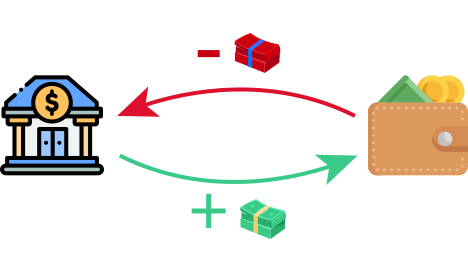
Whenever you use the Finance App (TVM Solver) on your calculator, it's critical that you enter and interpret the signs correctly:
problem image

When you receive money from a bank or savings account, that value is positive, because you're gaining money.


When you send money to a bank, that value is negative, because you're losing money.

Inflation & Real Value
SL Core 1.4

The real interest rate (needed when a question involves inflation) is given by ​r%=c%−i%, where ​c%​ represents the given interest rate (the nominal rate) and ​i%​ represents the inflation rate.


Note: You can calculate the real interest rate ​r%​ and enter it directly into the TVM solver (when required) as the nominal annual interest rate (​I%​ on your calculator), since the TVM solver does not account for inflation effects in its standard calculations.

Nice work completing Compounding (Appreciation & Depreciation), here's a quick recap of what we covered:

Skills covered

Mixed Practice

Exercises checked off

I'm Plex, here to help you understand this concept!
/
Sequences & Series
/
Compounding (Appreciation & Depreciation)
Mixed Practice
Compounding (Appreciation & Depreciation)
Sequences & Series

Compounding (Appreciation & Depreciation)

0 of 0 exercises completed

Compound growth, depreciation, interest, inflation, real value

Want a deeper conceptual understanding? Try our interactive lesson! (Plus Only)

Depreciation
SL Core 1.4
​
FV=PV×(1−100r​)n
​

where ​FV​ is the future value, ​PV​ is the present value, ​n​ is the number of years, and ​r%​ is the annual depreciation rate of the item.

Compound Interest Formula
SL Core 1.4
​
FV=PV×(1+100kr​)kn
​

where ​FV​ is the future value, ​PV​ is the present value, ​n​ is the number of years, ​k​ is the number of compounding periods per year, and ​r%​ is the nominal annual rate of interest.

Using TVM Solver (Calculator) - Compound Interest
SL Core 1.4

You should understand the meaning of each variable and know how to use your calculator's Finance/TVM Solver:

Field (on calculator)

Meaning

​N​

Total number of payment periods (i.e. ​ number of years​ ​× periods per year​).

​I%​

Nominal annual interest rate (expressed as a percent, NOT a decimal).

​PV​

Present value, or starting amount. At the start of the problem, if money leaves your pocket, PV must be negative. If money enters your pocket, PV must be positive.

​PMT​

Payment amount per period (for regular payments).

​FV​

Future value, or ending amount. At the end of the problem, if money enters your pocket, FV must be positive. If money leaves your pocket, FV must be negative.

​P​/​Y​

Payments per year. 12 for monthly payments, 4 for quarterly, 2 for semi-annual, and 1 for annual.

​C​/​Y​

Compounding periods per year. Same time periods as ​P/Y​ are possible.

​ PMT: End / Begin​

Payment timing mode. End means payments occur at the end of each period (most common). Begin means payments occur at the start of each period (like rent paid in advance).

To solve for an unknown, move your calculator's cursor to the unfilled slot and press alpha ​→​ enter.


Be very careful if P/Y is different from C/Y. The letter N will always be the number of payment periods, or in other words the number of years times P/Y.

Positive & Negative Cash Flows (TVM)
SL Core 1.4

Whenever you use the Finance App (TVM Solver) on your calculator, it's critical that you enter and interpret the signs correctly:

problem image

When you receive money from a bank or savings account, that value is positive, because you're gaining money.


When you send money to a bank, that value is negative, because you're losing money.

Inflation & Real Value
SL Core 1.4

The real interest rate (needed when a question involves inflation) is given by ​r%=c%−i%, where ​c%​ represents the given interest rate (the nominal rate) and ​i%​ represents the inflation rate.


Note: You can calculate the real interest rate ​r%​ and enter it directly into the TVM solver (when required) as the nominal annual interest rate (​I%​ on your calculator), since the TVM solver does not account for inflation effects in its standard calculations.

Nice work completing Compounding (Appreciation & Depreciation), here's a quick recap of what we covered:

Skills covered

Mixed Practice

Exercises checked off

I'm Plex, here to help you understand this concept!

Generating starter questions...

Generating starter questions...