Perplex
Dashboard
Topics
Exponents & LogarithmsApproximations & ErrorSequences & SeriesFinancial Mathematics
Cartesian plane & linesFunction TheoryModelling
2D & 3D GeometryVoronoi Diagrams
ProbabilityDescriptive StatisticsBivariate StatisticsDistributions & Random VariablesInference & Hypotheses
DifferentiationIntegration
Review VideosFormula BookletMy Progress
BlogLanding Page
Sign UpLogin
Perplex
Perplex
Dashboard
Topics
Exponents & LogarithmsApproximations & ErrorSequences & SeriesFinancial Mathematics
Cartesian plane & linesFunction TheoryModelling
2D & 3D GeometryVoronoi Diagrams
ProbabilityDescriptive StatisticsBivariate StatisticsDistributions & Random VariablesInference & Hypotheses
DifferentiationIntegration
Review VideosFormula BookletMy Progress
BlogLanding Page
Sign UpLogin
Perplex
IB Math AISL
/
Modelling
/
Skills
Edit

Skill Checklist

Track your progress across all skills in your objective. Mark your confidence level and identify areas to focus on.

Track your progress:

Don't know

Working on it

Confident

📖 = included in formula booklet • 🚫 = not in formula booklet

Track your progress:

Don't know

Working on it

Confident

📖 = included in formula booklet • 🚫 = not in formula booklet

IB Math AISL
/
Modelling
/
Skills
Edit

Skill Checklist

Track your progress across all skills in your objective. Mark your confidence level and identify areas to focus on.

Track your progress:

Don't know

Working on it

Confident

📖 = included in formula booklet • 🚫 = not in formula booklet

Track your progress:

Don't know

Working on it

Confident

📖 = included in formula booklet • 🚫 = not in formula booklet

Skill Checklist

Track your progress across all skills in your objective. Mark your confidence level and identify areas to focus on.

16 Skills Available

Track your progress:

Don't know

Working on it

Confident

📖 = included in formula booklet • 🚫 = not in formula booklet

Track your progress:

Don't know

Working on it

Confident

📖 = included in formula booklet • 🚫 = not in formula booklet

Linear Models and Modeling Skills

3 skills
Mathematical modelling and assumptions
SL AI 2.5

A mathematical model is an equation or graph that represents a real-world situation and can be used to analyze and make predictions about that situation. Mathematical models may be exact or approximate.


Because real-world scenarios usually involve many variables, we often identify the most important ones and making reasonable assumptions about the rest. A good model simplifies the situation as much as possible without significantly reducing the accuracy of its predictions.


In a mathematical model, constants and coefficients are called parameters. The general shape of a model is given by its family (linear, quadratic, exponential, etc.), but the more specific values (like intercepts, asymptotes, or steepness) are controlled by the parameters.

Linear models
SL AI 2.5

A linear model is represented by a straight-line graph.


Since a linear model can be defined by one point and a gradient or two points, they are the simplest models to construct. The most common form of a linear model is ​y=ax+b, where ​a​ is the slope and ​b​ is the ​y​-intercept.

Extrapolation
SL AI 2.5

Extrapolation is when we predict values beyond the domain of the given points. Extrapolating may work for certain situations, but it does not work for many others. Pay attention to the context of a model when extrapolating and consider whether the observed behavior is likely to change in the long-run.


Your understanding of extrapolation can be tested by questions that ask you to interpret plausible inputs and outputs.


Example

Between the ages of ​5​ and ​10, the height ​h​  ​cm​ of children can be modeled by

​
h=6a+80
​

where ​a​ is their age in years.


Extrapolation would be using this model for a ​40​ year old, which would give a prediction of ​h=6⋅40+80=320cm​ (around 10'6"). This is obviously crazy, and in this case it's obvious why a model for children's height does not apply to adults. But sometimes it's less obvious, and you should always be careful when extrapolating.

Piecewise Linear Models

1 skill
Piecewise Linear Models
SL AI 2.5

We use a piecewise linear model when different linear models apply over different parts of the domain of points. Basically, a piecewise linear model is a collection of smaller, domain-restricted models.


We write piecewise functions with the following notation:

​
f(x)={g(x),a<x<bh(x),b≤x<c​​
​

Quadratic Models

4 skills
Quadratic Models
SL AI 2.5

A quadratic model has a turning point (vertex) at which its minimum or maximum value occurs. The general form of a quadratic equation is ​ax2+bx+c.


If ​a<0, the turning point of a quadratic is its maximum; if ​a>0, the turning point of a quadratic is its minimum.

Fitting a quadratic model
SL AI 2.5

Given ​3​ pieces of data, we can solve for ​a,  ​b​ and ​c​ in a quadratic model ​ax2+bx+c.


Example

The points ​(1,−25),  ​(−1,−1)​ and ​(−3,7)​ lie on a parabola with equation ​y=ax2+bx+c. Find ​a,b​ and ​c.


Plugging in the ​x​ coordinates and setting equal to the ​y​-coordinates gives ​3​ equations:

​
⎩⎪⎨⎪⎧​a⋅12+b⋅1+c=−25a⋅(−1)2+b⋅(−1)+c=−1a⋅(−3)2+b⋅(−3)+c=7​⇒⎩⎪⎨⎪⎧​a+b+c=−25a−b+c=−19a−3b+c=7​
​

Solving this using a calculator gives ​a=−2,b=−12,c=−11. Thus the parabola has equation

​
y=−2x2−12x−11
​
Quadratic x-intercepts
SL AI 2.5

The roots of a quadratic correspond to the ​x​-intercepts of its graph. When ​x=a​ or ​x=β, the entire expression equals zero, which is reflected on the graph.


The equation of the parabola below is ​−(x−α)(x−β): 


Vertex and Axis of Symmetry
SL AI 2.5

The graph of a quadratic function has the general shape of a parabola.


It is symmetrical about the axis of symmetry and has a maxima or minima at the vertex, which lies on the axis of symmetry.

Cubic Models

1 skill
Cubic Models
SL AI 2.5

Cubic models have the form ​ax3+bx2+cx+d. Cubic graphs may have ​0​ or ​2​ turning points. When cubic graphs have ​0​ turning points, they have a short flat section where the function appears constant.

Exponential Models

3 skills
Exponential models
SL AI 2.5

An exponential model represents quantities that multiply repetetively by a constant factor ​b. The basic form of an exponential is ​bx, but any exponential can be written in the form ​Abx+k.


The graph of an exponential model is a curve that approaches a horizontal asymptote at ​y=k​ on one side, and has a ​y​-intercept at ​(0,A+k). Because of the asymptote on an exponential graph, exponential models are good at describing behaviors that level off over time.

Exponential growth
SL AI 2.5

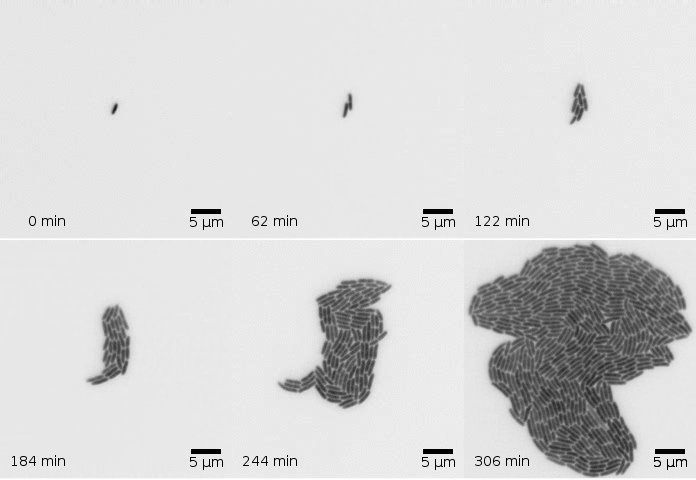
Exponential growth describes quantities that increase by the same factor over a certain amount of time. Algebraically, exponential growth is modeled by functions of the form

​
f(t)=Abt+c,
​

where ​b>1.  ​b​ is called the growth factor.


Note: ​Aekt​ is another model for exponential growth if the instantaneous growth rate, ​k, is positive.

problem image

Stewart EJ, Madden R, Paul G, Taddei F (2005), CC BY-SA 4.0

Exponential decay
SL AI 2.5

Exponential decay describes quantities that decrease by the same factor over a certain amount of time. Exponential decay is modeled by functions of the form

​
f(t)=Abt+c,
​

where ​0<b<1.  ​b​ is called the decay factor.


Note: ​Aekt​ is another model for exponential decay if the instantaneous growth rate, ​k, is negative.

Sinuisoidal Models

1 skill
Sinusoidal Models and their features
SL AI 2.5

Sinusoidal models describe quantities that repeat in regular intervals, or periodically, and are of the form ​y=asin(bx)+c​ or ​y=acos(bx)+c.


A sinusoidal curve ​y=acos(bx)+c​ is graphed below with key features.


The principal axis, the line around which the sinusoid oscillates, is given by ​y=c.


The amplitude, or the maximum distance the sinusoid reaches above and below the principal axis, is ​a.


The period, or the horizontal distance between consecutive maxima, is given by ​b360​°​ (or ​b2π​rad​ for HL).

Power Models & Proportionality

3 skills
Direct Proportion
SL AI 2.5

Directly proportional quantities are constant multiples of each other. In the context of modelling, we typically say, "​y​ varies directly with ​xn," which means ​y=kxn​ for some constant ​k. This can be denoted ​y∝xn.


If ​y​ is directly proportional to ​xn, then ​x=0⟺y=0.


If ​y​ is directly proportional to ​xn, then if ​x​ increases (or decreases) by a factor of ​c,  ​y​ increases (or decreases) by a factor of ​cn.

Inverse proportion
SL AI 2.5

If ​y​ varies inversely with ​xn, then ​y=xnk​.


If ​y​ is inversely proportional to ​xn​  ​(y∝xn1​), then the ​y​-axis is an asymptote of the graph of ​y=f(x).

Fitting a power model
SL AI 2.5

Proportionality relations can be used to build models called power models, which have the form

​
y=a⋅xb
​

which is equivalent to saying ​y∝xb. 


Power models can be found from given data using your calculator's power regression feature.

Skill Checklist

Track your progress across all skills in your objective. Mark your confidence level and identify areas to focus on.

16 Skills Available

Track your progress:

Don't know

Working on it

Confident

📖 = included in formula booklet • 🚫 = not in formula booklet

Track your progress:

Don't know

Working on it

Confident

📖 = included in formula booklet • 🚫 = not in formula booklet

Linear Models and Modeling Skills

3 skills
Mathematical modelling and assumptions
SL AI 2.5

A mathematical model is an equation or graph that represents a real-world situation and can be used to analyze and make predictions about that situation. Mathematical models may be exact or approximate.


Because real-world scenarios usually involve many variables, we often identify the most important ones and making reasonable assumptions about the rest. A good model simplifies the situation as much as possible without significantly reducing the accuracy of its predictions.


In a mathematical model, constants and coefficients are called parameters. The general shape of a model is given by its family (linear, quadratic, exponential, etc.), but the more specific values (like intercepts, asymptotes, or steepness) are controlled by the parameters.

Linear models
SL AI 2.5

A linear model is represented by a straight-line graph.


Since a linear model can be defined by one point and a gradient or two points, they are the simplest models to construct. The most common form of a linear model is ​y=ax+b, where ​a​ is the slope and ​b​ is the ​y​-intercept.

Extrapolation
SL AI 2.5

Extrapolation is when we predict values beyond the domain of the given points. Extrapolating may work for certain situations, but it does not work for many others. Pay attention to the context of a model when extrapolating and consider whether the observed behavior is likely to change in the long-run.


Your understanding of extrapolation can be tested by questions that ask you to interpret plausible inputs and outputs.


Example

Between the ages of ​5​ and ​10, the height ​h​  ​cm​ of children can be modeled by

​
h=6a+80
​

where ​a​ is their age in years.


Extrapolation would be using this model for a ​40​ year old, which would give a prediction of ​h=6⋅40+80=320cm​ (around 10'6"). This is obviously crazy, and in this case it's obvious why a model for children's height does not apply to adults. But sometimes it's less obvious, and you should always be careful when extrapolating.

Piecewise Linear Models

1 skill
Piecewise Linear Models
SL AI 2.5

We use a piecewise linear model when different linear models apply over different parts of the domain of points. Basically, a piecewise linear model is a collection of smaller, domain-restricted models.


We write piecewise functions with the following notation:

​
f(x)={g(x),a<x<bh(x),b≤x<c​​
​

Quadratic Models

4 skills
Quadratic Models
SL AI 2.5

A quadratic model has a turning point (vertex) at which its minimum or maximum value occurs. The general form of a quadratic equation is ​ax2+bx+c.


If ​a<0, the turning point of a quadratic is its maximum; if ​a>0, the turning point of a quadratic is its minimum.

Fitting a quadratic model
SL AI 2.5

Given ​3​ pieces of data, we can solve for ​a,  ​b​ and ​c​ in a quadratic model ​ax2+bx+c.


Example

The points ​(1,−25),  ​(−1,−1)​ and ​(−3,7)​ lie on a parabola with equation ​y=ax2+bx+c. Find ​a,b​ and ​c.


Plugging in the ​x​ coordinates and setting equal to the ​y​-coordinates gives ​3​ equations:

​
⎩⎪⎨⎪⎧​a⋅12+b⋅1+c=−25a⋅(−1)2+b⋅(−1)+c=−1a⋅(−3)2+b⋅(−3)+c=7​⇒⎩⎪⎨⎪⎧​a+b+c=−25a−b+c=−19a−3b+c=7​
​

Solving this using a calculator gives ​a=−2,b=−12,c=−11. Thus the parabola has equation

​
y=−2x2−12x−11
​
Quadratic x-intercepts
SL AI 2.5

The roots of a quadratic correspond to the ​x​-intercepts of its graph. When ​x=a​ or ​x=β, the entire expression equals zero, which is reflected on the graph.


The equation of the parabola below is ​−(x−α)(x−β): 


Vertex and Axis of Symmetry
SL AI 2.5

The graph of a quadratic function has the general shape of a parabola.


It is symmetrical about the axis of symmetry and has a maxima or minima at the vertex, which lies on the axis of symmetry.

Cubic Models

1 skill
Cubic Models
SL AI 2.5

Cubic models have the form ​ax3+bx2+cx+d. Cubic graphs may have ​0​ or ​2​ turning points. When cubic graphs have ​0​ turning points, they have a short flat section where the function appears constant.

Exponential Models

3 skills
Exponential models
SL AI 2.5

An exponential model represents quantities that multiply repetetively by a constant factor ​b. The basic form of an exponential is ​bx, but any exponential can be written in the form ​Abx+k.


The graph of an exponential model is a curve that approaches a horizontal asymptote at ​y=k​ on one side, and has a ​y​-intercept at ​(0,A+k). Because of the asymptote on an exponential graph, exponential models are good at describing behaviors that level off over time.

Exponential growth
SL AI 2.5

Exponential growth describes quantities that increase by the same factor over a certain amount of time. Algebraically, exponential growth is modeled by functions of the form

​
f(t)=Abt+c,
​

where ​b>1.  ​b​ is called the growth factor.


Note: ​Aekt​ is another model for exponential growth if the instantaneous growth rate, ​k, is positive.

problem image

Stewart EJ, Madden R, Paul G, Taddei F (2005), CC BY-SA 4.0

Exponential decay
SL AI 2.5

Exponential decay describes quantities that decrease by the same factor over a certain amount of time. Exponential decay is modeled by functions of the form

​
f(t)=Abt+c,
​

where ​0<b<1.  ​b​ is called the decay factor.


Note: ​Aekt​ is another model for exponential decay if the instantaneous growth rate, ​k, is negative.

Sinuisoidal Models

1 skill
Sinusoidal Models and their features
SL AI 2.5

Sinusoidal models describe quantities that repeat in regular intervals, or periodically, and are of the form ​y=asin(bx)+c​ or ​y=acos(bx)+c.


A sinusoidal curve ​y=acos(bx)+c​ is graphed below with key features.


The principal axis, the line around which the sinusoid oscillates, is given by ​y=c.


The amplitude, or the maximum distance the sinusoid reaches above and below the principal axis, is ​a.


The period, or the horizontal distance between consecutive maxima, is given by ​b360​°​ (or ​b2π​rad​ for HL).

Power Models & Proportionality

3 skills
Direct Proportion
SL AI 2.5

Directly proportional quantities are constant multiples of each other. In the context of modelling, we typically say, "​y​ varies directly with ​xn," which means ​y=kxn​ for some constant ​k. This can be denoted ​y∝xn.


If ​y​ is directly proportional to ​xn, then ​x=0⟺y=0.


If ​y​ is directly proportional to ​xn, then if ​x​ increases (or decreases) by a factor of ​c,  ​y​ increases (or decreases) by a factor of ​cn.

Inverse proportion
SL AI 2.5

If ​y​ varies inversely with ​xn, then ​y=xnk​.


If ​y​ is inversely proportional to ​xn​  ​(y∝xn1​), then the ​y​-axis is an asymptote of the graph of ​y=f(x).

Fitting a power model
SL AI 2.5

Proportionality relations can be used to build models called power models, which have the form

​
y=a⋅xb
​

which is equivalent to saying ​y∝xb. 


Power models can be found from given data using your calculator's power regression feature.