Perplex
Dashboard
Topics
Exponents & LogarithmsApproximations & ErrorSequences & SeriesFinancial Mathematics
Cartesian plane & linesFunction TheoryModelling
2D & 3D GeometryVoronoi Diagrams
ProbabilityDescriptive StatisticsBivariate StatisticsDistributions & Random VariablesInference & Hypotheses
DifferentiationIntegration
Review VideosFormula BookletMy Progress
BlogLanding Page
Sign UpLogin
Perplex
Perplex
Dashboard
Topics
Exponents & LogarithmsApproximations & ErrorSequences & SeriesFinancial Mathematics
Cartesian plane & linesFunction TheoryModelling
2D & 3D GeometryVoronoi Diagrams
ProbabilityDescriptive StatisticsBivariate StatisticsDistributions & Random VariablesInference & Hypotheses
DifferentiationIntegration
Review VideosFormula BookletMy Progress
BlogLanding Page
Sign UpLogin
Perplex
IB Math AISL
/
Financial Mathematics
/
Skills
Edit

Skill Checklist

Track your progress across all skills in your objective. Mark your confidence level and identify areas to focus on.

Track your progress:

Don't know

Working on it

Confident

📖 = included in formula booklet • 🚫 = not in formula booklet

Track your progress:

Don't know

Working on it

Confident

📖 = included in formula booklet • 🚫 = not in formula booklet

IB Math AISL
/
Financial Mathematics
/
Skills
Edit

Skill Checklist

Track your progress across all skills in your objective. Mark your confidence level and identify areas to focus on.

Track your progress:

Don't know

Working on it

Confident

📖 = included in formula booklet • 🚫 = not in formula booklet

Track your progress:

Don't know

Working on it

Confident

📖 = included in formula booklet • 🚫 = not in formula booklet

Skill Checklist

Track your progress across all skills in your objective. Mark your confidence level and identify areas to focus on.

9 Skills Available

Track your progress:

Don't know

Working on it

Confident

📖 = included in formula booklet • 🚫 = not in formula booklet

Track your progress:

Don't know

Working on it

Confident

📖 = included in formula booklet • 🚫 = not in formula booklet

Compounding (Appreciation & Depreciation)

5 skills
Depreciation
SL Core 1.4
​
FV=PV×(1−100r​)n
​

where ​FV​ is the future value, ​PV​ is the present value, ​n​ is the number of years, and ​r%​ is the annual depreciation rate of the item.

Compound Interest Formula
SL Core 1.4
​
FV=PV×(1+100kr​)kn
​

where ​FV​ is the future value, ​PV​ is the present value, ​n​ is the number of years, ​k​ is the number of compounding periods per year, and ​r%​ is the nominal annual rate of interest.

Using TVM Solver (Calculator) - Compound Interest
SL Core 1.4

You should understand the meaning of each variable and know how to use your calculator's Finance/TVM Solver:

Field (on calculator)

Meaning

​N​

Total number of payment periods (i.e. ​ number of years​  ​× periods per year​).

​I%​

Nominal annual interest rate (expressed as a percent, NOT a decimal).

​PV​

Present value, or starting amount. At the start of the problem, if money leaves your pocket, PV must be negative. If money enters your pocket, PV must be positive.

​PMT​

Payment amount per period (for regular payments).

​FV​

Future value, or ending amount. At the end of the problem, if money enters your pocket, FV must be positive. If money leaves your pocket, FV must be negative.

​P​/​Y​

Payments per year. 12 for monthly payments, 4 for quarterly, 2 for semi-annual, and 1 for annual.

​C​/​Y​

Compounding periods per year. Same time periods as ​P/Y​ are possible.

​ PMT: End / Begin​

Payment timing mode. End means payments occur at the end of each period (most common). Begin means payments occur at the start of each period (like rent paid in advance).

To solve for an unknown, move your calculator's cursor to the unfilled slot and press alpha ​→​ enter.


Be very careful if P/Y is different from C/Y. The letter N will always be the number of payment periods, or in other words the number of years times P/Y.

Positive & Negative Cash Flows (TVM)
SL Core 1.4

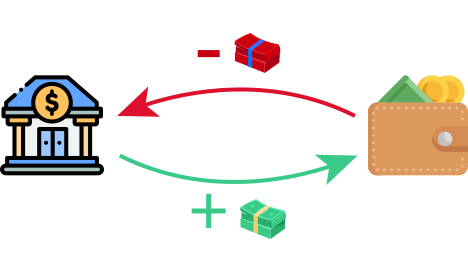
Whenever you use the Finance App (TVM Solver) on your calculator, it's critical that you enter and interpret the signs correctly:
problem image

When you receive money from a bank or savings account, that value is positive, because you're gaining money.


When you send money to a bank, that value is negative, because you're losing money.

Inflation & Real Value
SL Core 1.4

The real interest rate (needed when a question involves inflation) is given by ​r%=c%−i%, where ​c%​ represents the given interest rate (the nominal rate) and ​i%​ represents the inflation rate.


Note: You can calculate the real interest rate ​r%​ and enter it directly into the TVM solver (when required) as the nominal annual interest rate (​I%​ on your calculator), since the TVM solver does not account for inflation effects in its standard calculations.

Loans

3 skills
Definition of a loan / amortization
SL AI 1.7

A loan is when money is borrowed and later repaid over time. In the IB (and most real world settings), the person who borrows money agrees to make a payment at regular intervals (for example monthly or yearly).


As a reward for the person who lends (gives) the money, the borrower also pays interest, typically a percentage of the loan amount. The payment amount is calculated such that the loan is fully repaid (with interest) by the end of an agreed upon period of time.

Positive & Negative Cash Flows (TVM)
SL Core 1.4

Whenever you use the Finance App (TVM Solver) on your calculator, it's critical that you enter and interpret the signs correctly:

problem image

When you receive money from a bank or savings account, that value is positive, because you're gaining money.


When you send money to a bank, that value is negative, because you're losing money.

Using TVM Solver (Calculator) - Loans
SL Core 1.4

In IB, loans are paid off at the end of a number of periods (​N​) and have an annual interest rate (​I%​), an initial balance (​PV​), a fixed payment (​PMT​), and an outstanding balance (​FV​). Payments per year and compounds per year typically occur at the same frequency (​P/Y,  ​C/Y​).


You can use the TVM solver with loans to find any of those variables if you know all the others.

Annuities

3 skills
Definition of an annuity
SL AI 1.7

An annuity is a type of account that a person can live off when they retire. They make regular withdrawals, and the interest on the account allows the money to last longer. The money in an annuity account is often built up over a lifetime of saving and compounding, but it can also be deposited in a lump-sum.


Effectively, an annuity is the reverse of a loan. Instead of the bank lending you money, you lend the bank money, and they make regular repayments back to you over time.

Using TVM Solver (Calculator) - Annuities
SL Core 1.4

You should be able to use the TVM Solver on your calculator to perform calculations with annuities.


In IB, annuities are paid at the end of a number of periods (​N​) and have an annual interest rate (​I%​), an initial lump-sum deposit ​(PV), a fixed payment (​PMT​) and a future value (​FV​), which represents the total accumulated amount at the end of the term.


In the special case of annuities, payments and compounding occur can occur at different same frequencies (​P/Y​ & ​C/Y​).

Positive & Negative Cash Flows (TVM)
SL Core 1.4

Whenever you use the Finance App (TVM Solver) on your calculator, it's critical that you enter and interpret the signs correctly:

problem image

When you receive money from a bank or savings account, that value is positive, because you're gaining money.


When you send money to a bank, that value is negative, because you're losing money.

Skill Checklist

Track your progress across all skills in your objective. Mark your confidence level and identify areas to focus on.

9 Skills Available

Track your progress:

Don't know

Working on it

Confident

📖 = included in formula booklet • 🚫 = not in formula booklet

Track your progress:

Don't know

Working on it

Confident

📖 = included in formula booklet • 🚫 = not in formula booklet

Compounding (Appreciation & Depreciation)

5 skills
Depreciation
SL Core 1.4
​
FV=PV×(1−100r​)n
​

where ​FV​ is the future value, ​PV​ is the present value, ​n​ is the number of years, and ​r%​ is the annual depreciation rate of the item.

Compound Interest Formula
SL Core 1.4
​
FV=PV×(1+100kr​)kn
​

where ​FV​ is the future value, ​PV​ is the present value, ​n​ is the number of years, ​k​ is the number of compounding periods per year, and ​r%​ is the nominal annual rate of interest.

Using TVM Solver (Calculator) - Compound Interest
SL Core 1.4

You should understand the meaning of each variable and know how to use your calculator's Finance/TVM Solver:

Field (on calculator)

Meaning

​N​

Total number of payment periods (i.e. ​ number of years​  ​× periods per year​).

​I%​

Nominal annual interest rate (expressed as a percent, NOT a decimal).

​PV​

Present value, or starting amount. At the start of the problem, if money leaves your pocket, PV must be negative. If money enters your pocket, PV must be positive.

​PMT​

Payment amount per period (for regular payments).

​FV​

Future value, or ending amount. At the end of the problem, if money enters your pocket, FV must be positive. If money leaves your pocket, FV must be negative.

​P​/​Y​

Payments per year. 12 for monthly payments, 4 for quarterly, 2 for semi-annual, and 1 for annual.

​C​/​Y​

Compounding periods per year. Same time periods as ​P/Y​ are possible.

​ PMT: End / Begin​

Payment timing mode. End means payments occur at the end of each period (most common). Begin means payments occur at the start of each period (like rent paid in advance).

To solve for an unknown, move your calculator's cursor to the unfilled slot and press alpha ​→​ enter.


Be very careful if P/Y is different from C/Y. The letter N will always be the number of payment periods, or in other words the number of years times P/Y.

Positive & Negative Cash Flows (TVM)
SL Core 1.4

Whenever you use the Finance App (TVM Solver) on your calculator, it's critical that you enter and interpret the signs correctly:

problem image

When you receive money from a bank or savings account, that value is positive, because you're gaining money.


When you send money to a bank, that value is negative, because you're losing money.

Inflation & Real Value
SL Core 1.4

The real interest rate (needed when a question involves inflation) is given by ​r%=c%−i%, where ​c%​ represents the given interest rate (the nominal rate) and ​i%​ represents the inflation rate.


Note: You can calculate the real interest rate ​r%​ and enter it directly into the TVM solver (when required) as the nominal annual interest rate (​I%​ on your calculator), since the TVM solver does not account for inflation effects in its standard calculations.

Loans

3 skills
Definition of a loan / amortization
SL AI 1.7

A loan is when money is borrowed and later repaid over time. In the IB (and most real world settings), the person who borrows money agrees to make a payment at regular intervals (for example monthly or yearly).


As a reward for the person who lends (gives) the money, the borrower also pays interest, typically a percentage of the loan amount. The payment amount is calculated such that the loan is fully repaid (with interest) by the end of an agreed upon period of time.

Positive & Negative Cash Flows (TVM)
SL Core 1.4

Whenever you use the Finance App (TVM Solver) on your calculator, it's critical that you enter and interpret the signs correctly:

problem image

When you receive money from a bank or savings account, that value is positive, because you're gaining money.


When you send money to a bank, that value is negative, because you're losing money.

Using TVM Solver (Calculator) - Loans
SL Core 1.4

In IB, loans are paid off at the end of a number of periods (​N​) and have an annual interest rate (​I%​), an initial balance (​PV​), a fixed payment (​PMT​), and an outstanding balance (​FV​). Payments per year and compounds per year typically occur at the same frequency (​P/Y,  ​C/Y​).


You can use the TVM solver with loans to find any of those variables if you know all the others.

Annuities

3 skills
Definition of an annuity
SL AI 1.7

An annuity is a type of account that a person can live off when they retire. They make regular withdrawals, and the interest on the account allows the money to last longer. The money in an annuity account is often built up over a lifetime of saving and compounding, but it can also be deposited in a lump-sum.


Effectively, an annuity is the reverse of a loan. Instead of the bank lending you money, you lend the bank money, and they make regular repayments back to you over time.

Using TVM Solver (Calculator) - Annuities
SL Core 1.4

You should be able to use the TVM Solver on your calculator to perform calculations with annuities.


In IB, annuities are paid at the end of a number of periods (​N​) and have an annual interest rate (​I%​), an initial lump-sum deposit ​(PV), a fixed payment (​PMT​) and a future value (​FV​), which represents the total accumulated amount at the end of the term.


In the special case of annuities, payments and compounding occur can occur at different same frequencies (​P/Y​ & ​C/Y​).

Positive & Negative Cash Flows (TVM)
SL Core 1.4

Whenever you use the Finance App (TVM Solver) on your calculator, it's critical that you enter and interpret the signs correctly:

problem image

When you receive money from a bank or savings account, that value is positive, because you're gaining money.


When you send money to a bank, that value is negative, because you're losing money.