Perplex
Dashboard
Topics
Exponents & LogarithmsApproximations & ErrorSequences & SeriesMatricesComplex NumbersFinancial Mathematics
Cartesian plane & linesFunction TheoryModellingTransformations & asymptotes
2D & 3D GeometryVoronoi DiagramsTrig equations & identitiesVectorsGraph Theory
ProbabilityDescriptive StatisticsBivariate StatisticsDistributions & Random VariablesInference & Hypotheses
DifferentiationIntegrationDifferential Equations
Review VideosFormula BookletMy Progress
BlogLanding Page
Sign UpLogin
Perplex
Perplex
Dashboard
Topics
Exponents & LogarithmsApproximations & ErrorSequences & SeriesMatricesComplex NumbersFinancial Mathematics
Cartesian plane & linesFunction TheoryModellingTransformations & asymptotes
2D & 3D GeometryVoronoi DiagramsTrig equations & identitiesVectorsGraph Theory
ProbabilityDescriptive StatisticsBivariate StatisticsDistributions & Random VariablesInference & Hypotheses
DifferentiationIntegrationDifferential Equations
Review VideosFormula BookletMy Progress
BlogLanding Page
Sign UpLogin
Perplex
/
Differentiation
/
Differentiation rules
Tangents and normals
Differentiation rules
Differentiation

Differentiation rules

0 of 0 exercises completed

Power rule, chain rule, product rule, quotient rule, derivatives of ​ex,  ​ax,  ​loga​(x), trigonometric, and inverse trigonometric functions

Want a deeper conceptual understanding? Try our interactive lesson!

Derivative of xⁿ where n is an integer
SL 5.3
​
f(x)=xn, n∈Z⇒f′(x)=nxn−1📖
​
Derivatives of sums and scalar multiples
SL 5.3
​
dxd​(af(x))=af′(x)🚫
​
​
dxd​(f(x)+g(x))=f′(x)+g′(x)🚫
​
​
dxd​(af(x)+bg(x))=af′(x)+bg′(x)🚫
​
Derivative of xⁿ where n is rational
AHL AI 5.9
​
f(x)=xn, n∈Q⇒f′(x)=nxn−1📖
​
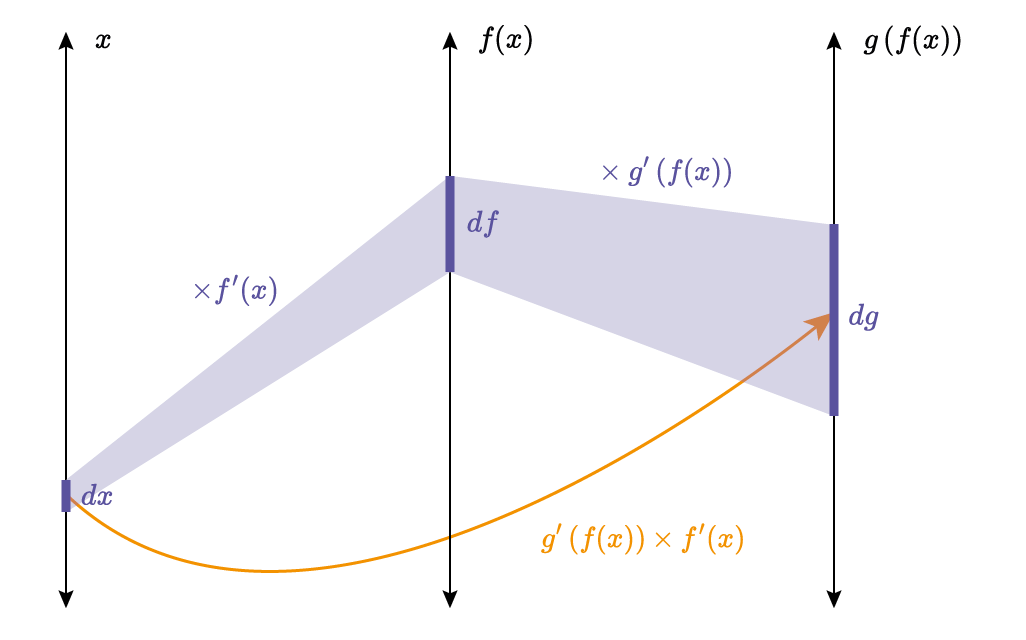
Chain rule
AHL AI 5.9
​
(g(f(x)))′=g′(f(x))⋅f′(x)🚫
​
​
y=g(u) where u=f(x)
​
​
dxdy​=dudg​⋅dxdu​📖
​
Derivative of e^x
AHL AI 5.9
​
f(x)=ex⇒f′(x)=ex📖
​
Derivative of ln
AHL AI 5.9
​
f(x)=lnx⇒f′(x)=x1​📖
​
Product and Quotient rule
AHL AI 5.9

The product and quotient rules are given by

​
(uv)′=u′v+v′u📖
​
​
(vu​)′=v2u′v−v′u​📖
​
Derivatives of sin and cos
AHL AI 5.9
​
f(x)=sinx⇒f′(x)=cosx📖
​
​
g(x)=cosx⇒g′(x)=−sinx📖
​
Derivative of tan(x)
AHL AI 5.9
​
f(x)=tanx⇒f′(x)=sec2(x)📖
​
Implicit Derivative: Horizontal and vertical tangents & normals

In problems involving implicit derivatives, you may be asked to solve for points where the tangent to the curve is horizontal or vertical. A horizontal tangent means ​dxdy​=0, and a vertical tangent occurs in the case where ​dxdy​=denominatornumerator​​ and the denominator equals zero.

If the question asks for vertical / horizontal normals, just recall that a vertical normal means a horizontal tangent, and vice-versa.

Nice work completing Differentiation rules, here's a quick recap of what we covered:

Skills covered

Mixed Practice

Exercises checked off

I'm Plex, here to help you understand this concept!
/
Differentiation
/
Differentiation rules
Tangents and normals
Differentiation rules
Differentiation

Differentiation rules

0 of 0 exercises completed

Power rule, chain rule, product rule, quotient rule, derivatives of ​ex,  ​ax,  ​loga​(x), trigonometric, and inverse trigonometric functions

Want a deeper conceptual understanding? Try our interactive lesson!

Derivative of xⁿ where n is an integer
SL 5.3
​
f(x)=xn, n∈Z⇒f′(x)=nxn−1📖
​
Derivatives of sums and scalar multiples
SL 5.3
​
dxd​(af(x))=af′(x)🚫
​
​
dxd​(f(x)+g(x))=f′(x)+g′(x)🚫
​
​
dxd​(af(x)+bg(x))=af′(x)+bg′(x)🚫
​
Derivative of xⁿ where n is rational
AHL AI 5.9
​
f(x)=xn, n∈Q⇒f′(x)=nxn−1📖
​
Chain rule
AHL AI 5.9
​
(g(f(x)))′=g′(f(x))⋅f′(x)🚫
​
​
y=g(u) where u=f(x)
​
​
dxdy​=dudg​⋅dxdu​📖
​
Derivative of e^x
AHL AI 5.9
​
f(x)=ex⇒f′(x)=ex📖
​
Derivative of ln
AHL AI 5.9
​
f(x)=lnx⇒f′(x)=x1​📖
​
Product and Quotient rule
AHL AI 5.9

The product and quotient rules are given by

​
(uv)′=u′v+v′u📖
​
​
(vu​)′=v2u′v−v′u​📖
​
Derivatives of sin and cos
AHL AI 5.9
​
f(x)=sinx⇒f′(x)=cosx📖
​
​
g(x)=cosx⇒g′(x)=−sinx📖
​
Derivative of tan(x)
AHL AI 5.9
​
f(x)=tanx⇒f′(x)=sec2(x)📖
​
Implicit Derivative: Horizontal and vertical tangents & normals

In problems involving implicit derivatives, you may be asked to solve for points where the tangent to the curve is horizontal or vertical. A horizontal tangent means ​dxdy​=0, and a vertical tangent occurs in the case where ​dxdy​=denominatornumerator​​ and the denominator equals zero.

If the question asks for vertical / horizontal normals, just recall that a vertical normal means a horizontal tangent, and vice-versa.

Nice work completing Differentiation rules, here's a quick recap of what we covered:

Skills covered

Mixed Practice

Exercises checked off

I'm Plex, here to help you understand this concept!

Generating starter questions...

Generating starter questions...