Perplex
Dashboard
Topics
Exponents & LogarithmsApproximations & ErrorSequences & SeriesMatricesComplex NumbersFinancial Mathematics
Cartesian plane & linesFunction TheoryModellingTransformations & asymptotes
2D & 3D GeometryVoronoi DiagramsTrig equations & identitiesVectorsGraph Theory
ProbabilityDescriptive StatisticsBivariate StatisticsDistributions & Random VariablesInference & Hypotheses
DifferentiationIntegrationDifferential Equations
Review VideosFormula BookletMy Progress
BlogLanding Page
Sign UpLogin
Perplex
Perplex
Dashboard
Topics
Exponents & LogarithmsApproximations & ErrorSequences & SeriesMatricesComplex NumbersFinancial Mathematics
Cartesian plane & linesFunction TheoryModellingTransformations & asymptotes
2D & 3D GeometryVoronoi DiagramsTrig equations & identitiesVectorsGraph Theory
ProbabilityDescriptive StatisticsBivariate StatisticsDistributions & Random VariablesInference & Hypotheses
DifferentiationIntegrationDifferential Equations
Review VideosFormula BookletMy Progress
BlogLanding Page
Sign UpLogin
Perplex
IB Math AIHL
/
Approximations & Error
/
Skills
Edit

Skill Checklist

Track your progress across all skills in your objective. Mark your confidence level and identify areas to focus on.

Track your progress:

Don't know

Working on it

Confident

📖 = included in formula booklet • 🚫 = not in formula booklet

Track your progress:

Don't know

Working on it

Confident

📖 = included in formula booklet • 🚫 = not in formula booklet

IB Math AIHL
/
Approximations & Error
/
Skills
Edit

Skill Checklist

Track your progress across all skills in your objective. Mark your confidence level and identify areas to focus on.

Track your progress:

Don't know

Working on it

Confident

📖 = included in formula booklet • 🚫 = not in formula booklet

Track your progress:

Don't know

Working on it

Confident

📖 = included in formula booklet • 🚫 = not in formula booklet

Skill Checklist

Track your progress across all skills in your objective. Mark your confidence level and identify areas to focus on.

8 Skills Available

Track your progress:

Don't know

Working on it

Confident

📖 = included in formula booklet • 🚫 = not in formula booklet

Track your progress:

Don't know

Working on it

Confident

📖 = included in formula booklet • 🚫 = not in formula booklet

Rounding Numbers

2 skills
Rounding rules
SL Core 1.1

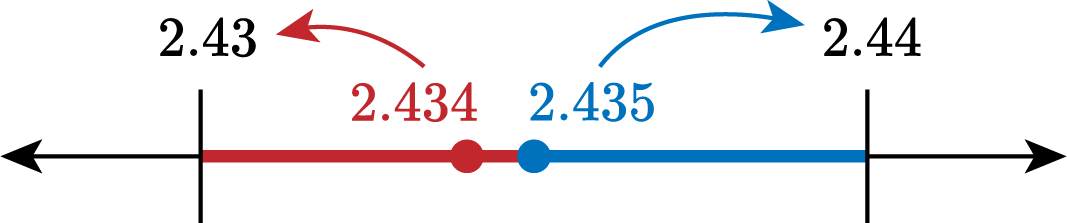
There are standardized rules for how to approximate numerical values:

  • If the digit after the one being rounded off is LESS than ​5​ (​0,1,2,3,​ or ​4​), we round down.

  • If the digit after the one being rounded off is ​5​ OR MORE (​5,6,7,8,​ or ​9​), we round up.

    ​
    1.34∣5→1.35
    ​
    ​
    1.34∣4→1.34
    ​
Significant figures
SL Core 1.1

A significant figure is any digit that is not a leading or trailing zero. To round off to a number of significant figures, count off the specified number of significant figures, then round based off of rounding rules (down if the next digit is less than ​5, up if the digit is ​5​ or more).

problem image


NOTE: Unless a question states otherwise, on IB exams, you are expected to give answers to 3 significant figures.

Scientific Notation

3 skills
Writing numbers in standard form
SL Core 1.1

Scientific notation is a useful way to write large or small numbers in a compact form. It uses powers of ​10​ to "condense" a lot of digits. Numbers written in scientific notation are of the form

​
a×10k
​

where ​1≤a<10​ and ​k∈Z.

Scientific notation is sometimes called "standard form."

Adding & subtracting numbers in scientific notation
SL Core 1.1

Let ​x=3×10⁵,y=4×10⁶, and suppose we want to find ​x+y.


Since the powers of ​10​ are different, we cannot simply add ​3+4. Instead, we rewrite ​y​ so it is multiplying ​105:

​
y=4×106=4×10⁵+1=40×105
​

Now we can add:

​
x+y=3×10⁵+40×105=43×105
​

Finally, we convert back to scientific form, since ​43>10:

​
x+y=4.3×10⁶
​


Basically, we took the higher power of ​10​ and "split" it so that it matched the smaller power of ​10. 

Multiplying & dividing numbers in scientific notation
SL Core 1.1

We can multiply and divide numbers in scientific form as follows:

​
(3×109)×(4×105)=12×1014=1.2×10¹⁵
​
​
4×1053×109​=0.75×104=7.5×10³
​

Multiplying and dividing numbers in scientific notation relies heavily on exponent rules.

Error

3 skills
Approximation error bounds
SL AI 1.6

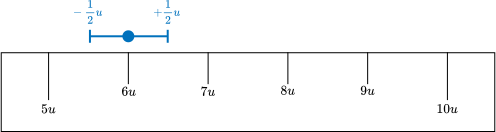
A measurement is always accurate to ​±21​​ ("plus or minus one half") of the smallest division on the scale. The same idea applies to rounding numbers: the rounded value is accurate to ​±21​​ the value of the digit "place" (tens, ones, tenths, hundredths, etc.) it is rounded to.
problem image

Typically, we express the error bounds of a number ​x​ using inequalities:

​
x−21​u≤x<x+21​u
​

where ​x​ is the measured value, ​u​ is the smallest unit on the scale we used. Note that some people equivalently write

​
x∈[x−21​u,x+21​u)
​

The upper bound, ​x+21​u, is not included since it would be rounded up to the next increment.

Absolute and percentage error
SL AI 1.6

The actual size of an error is the difference between the approximated value (​VA​​) and the exact value (​VE​​). We call this the absolute error, and can calculate it with the equation

​
absolute error =∣VA​−VE​∣
​

Expressing the error as a percentage of the exact value allows us to see how much the error "matters" in a specific scenario. This is the percentage error, which we calculate with the equation

​
percentage error =VE​∣VA​−VE​∣​×100%
​
Bounds of calculation based on other approximations
SL AI 1.6

The error bounds of values like length and width impact the error bounds of any secondary calculation, like area, that we use them to find. For example, if an object of length ​l​ and width ​w​ has error bounds ​0.9≤l≤1.1​ and ​2.6≤w≤2.9, then the object's minimum and maximum area are

​
Amin​=0.9(2.6)=2.34
​
​
Amax​=1.1(2.9)=3.19
​

i.e., the error bounds are ​2.34≤A<3.19.

Skill Checklist

Track your progress across all skills in your objective. Mark your confidence level and identify areas to focus on.

8 Skills Available

Track your progress:

Don't know

Working on it

Confident

📖 = included in formula booklet • 🚫 = not in formula booklet

Track your progress:

Don't know

Working on it

Confident

📖 = included in formula booklet • 🚫 = not in formula booklet

Rounding Numbers

2 skills
Rounding rules
SL Core 1.1

There are standardized rules for how to approximate numerical values:

  • If the digit after the one being rounded off is LESS than ​5​ (​0,1,2,3,​ or ​4​), we round down.

  • If the digit after the one being rounded off is ​5​ OR MORE (​5,6,7,8,​ or ​9​), we round up.

    ​
    1.34∣5→1.35
    ​
    ​
    1.34∣4→1.34
    ​
Significant figures
SL Core 1.1

A significant figure is any digit that is not a leading or trailing zero. To round off to a number of significant figures, count off the specified number of significant figures, then round based off of rounding rules (down if the next digit is less than ​5, up if the digit is ​5​ or more).

problem image


NOTE: Unless a question states otherwise, on IB exams, you are expected to give answers to 3 significant figures.

Scientific Notation

3 skills
Writing numbers in standard form
SL Core 1.1

Scientific notation is a useful way to write large or small numbers in a compact form. It uses powers of ​10​ to "condense" a lot of digits. Numbers written in scientific notation are of the form

​
a×10k
​

where ​1≤a<10​ and ​k∈Z.

Scientific notation is sometimes called "standard form."

Adding & subtracting numbers in scientific notation
SL Core 1.1

Let ​x=3×10⁵,y=4×10⁶, and suppose we want to find ​x+y.


Since the powers of ​10​ are different, we cannot simply add ​3+4. Instead, we rewrite ​y​ so it is multiplying ​105:

​
y=4×106=4×10⁵+1=40×105
​

Now we can add:

​
x+y=3×10⁵+40×105=43×105
​

Finally, we convert back to scientific form, since ​43>10:

​
x+y=4.3×10⁶
​


Basically, we took the higher power of ​10​ and "split" it so that it matched the smaller power of ​10. 

Multiplying & dividing numbers in scientific notation
SL Core 1.1

We can multiply and divide numbers in scientific form as follows:

​
(3×109)×(4×105)=12×1014=1.2×10¹⁵
​
​
4×1053×109​=0.75×104=7.5×10³
​

Multiplying and dividing numbers in scientific notation relies heavily on exponent rules.

Error

3 skills
Approximation error bounds
SL AI 1.6

A measurement is always accurate to ​±21​​ ("plus or minus one half") of the smallest division on the scale. The same idea applies to rounding numbers: the rounded value is accurate to ​±21​​ the value of the digit "place" (tens, ones, tenths, hundredths, etc.) it is rounded to.

problem image

Typically, we express the error bounds of a number ​x​ using inequalities:

​
x−21​u≤x<x+21​u
​

where ​x​ is the measured value, ​u​ is the smallest unit on the scale we used. Note that some people equivalently write

​
x∈[x−21​u,x+21​u)
​

The upper bound, ​x+21​u, is not included since it would be rounded up to the next increment.

Absolute and percentage error
SL AI 1.6

The actual size of an error is the difference between the approximated value (​VA​​) and the exact value (​VE​​). We call this the absolute error, and can calculate it with the equation

​
absolute error =∣VA​−VE​∣
​

Expressing the error as a percentage of the exact value allows us to see how much the error "matters" in a specific scenario. This is the percentage error, which we calculate with the equation

​
percentage error =VE​∣VA​−VE​∣​×100%
​
Bounds of calculation based on other approximations
SL AI 1.6

The error bounds of values like length and width impact the error bounds of any secondary calculation, like area, that we use them to find. For example, if an object of length ​l​ and width ​w​ has error bounds ​0.9≤l≤1.1​ and ​2.6≤w≤2.9, then the object's minimum and maximum area are

​
Amin​=0.9(2.6)=2.34
​
​
Amax​=1.1(2.9)=3.19
​

i.e., the error bounds are ​2.34≤A<3.19.