Topics
Skill Checklist
Track your progress across all skills in your objective. Mark your confidence level and identify areas to focus on.
24 Skills Available
Track your progress:
Don't know
Working on it
Confident
📖 = included in formula booklet • 🚫 = not in formula booklet
Track your progress:
Don't know
Working on it
Confident
📖 = included in formula booklet • 🚫 = not in formula booklet
Right angled triangles
5 skills
Area of triangle equals ½bh
1. Prior learning
The area of a triangle is given by
A=21(bh)📖
where b is the base and h is the height.
Pythagoras' Theorem
3. Prior learning
In a right angled triangle with sides a, b and hypotenuse (longest side) c, Pythagoras' Theorem states
a2+b2=c2🚫
Trigonometric Ratios
SL Core 3.2
In a right angled triangle with an angle θ<90°, the trigonometric ratios sin, cos and tan are defined by
sinθ cosθ tanθ=hypotenuseopposite =hypotenuseadjacent =adjacentopposite
where opposite and adjacent refer to the side lengths of the sides opposite and adjacent to θ, while hypotenuse is the length of the longest side.
Finding angles in right angled triangles
SL Core 3.2
If we know the value of sinθ, cosθ or tanθ in a right angled triangle, we can find θ using an inverse trigonometric function on a calculator. These functions are sin−1, cos−1 and tan−1 and satisfy
sin−1(sinθ)cos−1(cosθ)tan−1(tanθ)=θ=θ=θ
whenever θ<90°, which is always true in a right angled triangle.
Finding side lengths from an angle in right triangle
SL Core 3.2
Trigonometric functions can also be used to find an unknown side length in a right triangle:
We know that
sin33°=ho=3x⇒x=3sin33°=1.63
Non-right-angled triangles
3 skills
Area of non-right-angled triangles
SL Core 3.2
When we know two side lengths and the angle between the two sides, we can find the area even if we don't directly know the height by using the fact that
sinC=ah⇒h=asinC
Thus
A=21(bh)=21absinC📖
Sine rule
SL Core 3.2
The previously found formula for area
A=21absinC📖
applies to any pair of sides and the angle between them. Since the area is the same no matter which sides we use:
21absinC=21bcsinA=21acsinB
Multiplying everything by 2 and dividing by abc:
csinC=asinA=BsinB🚫
Flipping the numerator and denominator gives the form that appears in the formula booklet:
sinAa=sinBb=sinCc📖
The sine rule is primarily used when we know two angles and a side. When we know two sides and an angle, the version with angles in the numerator is easier to work with.
Cosine rule
SL Core 3.2
The cosine rule is a generalization of Pythagoras' theorem for non-right-angled triangles. It states that
c2=a2+b2−2abcosC📖
The cosine rule is primarily used when we
know two sides and the angle between them, and want to find the third side,
know all three sides and want to find an angle.
Circles: Radians, arcs and sectors
7 skills
Circumference & Area of a circle
SL AI 3.4
The ratio of a circle's perimeter to its diameter is constant in all circles. This constant is called π (pi). Since the diameter is twice the radius, the circumference of a circle is
C=2πr📖
The area of a circle is
A=πr2📖
where r is the radius of the circle.
Arc length (degrees)
SL AI 3.4
An arc is part of the circumference of a circle. It is defined by the radius r of the circle and the angle θ that the arc "sweeps out" over the circle's perimeter.
Since the arc length is a fraction of the overall circumference determined by the value of the angle θ, the arc length is calculated as
l=360∘θ×2πr
Sector (degrees)
SL AI 3.4
A sector is an area enclosed between a circular arc and the two radii of the circle touching each end of the arc, like a slice of pizza.
The area of a circle is πr2, and there are 360 degrees of rotation in a circle. Therefore, a sector with central angle θ is 360∘θ of a full circle, and has area
A=360∘θ×πr2
Radian measure
AHL AI 3.7
One radian is the interior angle of an arc which has a length equivalent to the radius r of the circle. Since the circumference of a circle is given by 2πr, then, there are 2π total radians in a circle (the equivalent of 360°).
Converting Between Radians & Degrees
AHL AI 3.7
Since the perimeter of a full circle is 2πr, the angle θ corresponding to a full circle (360°) is
r2πrrad=360°
So
πrad=180°🚫
Some key angles in radians and degrees:
Arc length (radians)
AHL AI 3.7
An arc is defined by the radius r of the circle and the angle θ that the arc "sweeps out" over the circle's perimeter.
Since the arc length is a fraction of the overall circumference determined by the value of the angle θ, the arc length is calculated as
l=rθ
Sector area (radians)
AHL AI 3.7
A sector is an area enclosed between a circular arc and the two radii of the circle touching each end of the arc:
The area of a circle is πr2, and there are 2π radians in a circle. Therefore, a sector with central angle θ is 2πθ of a full circle, and has area
A=2πθ⋅πr2
so
A=21θr2📖
3D space & solids
7 skills
3D coordinates
SL Core 3.1
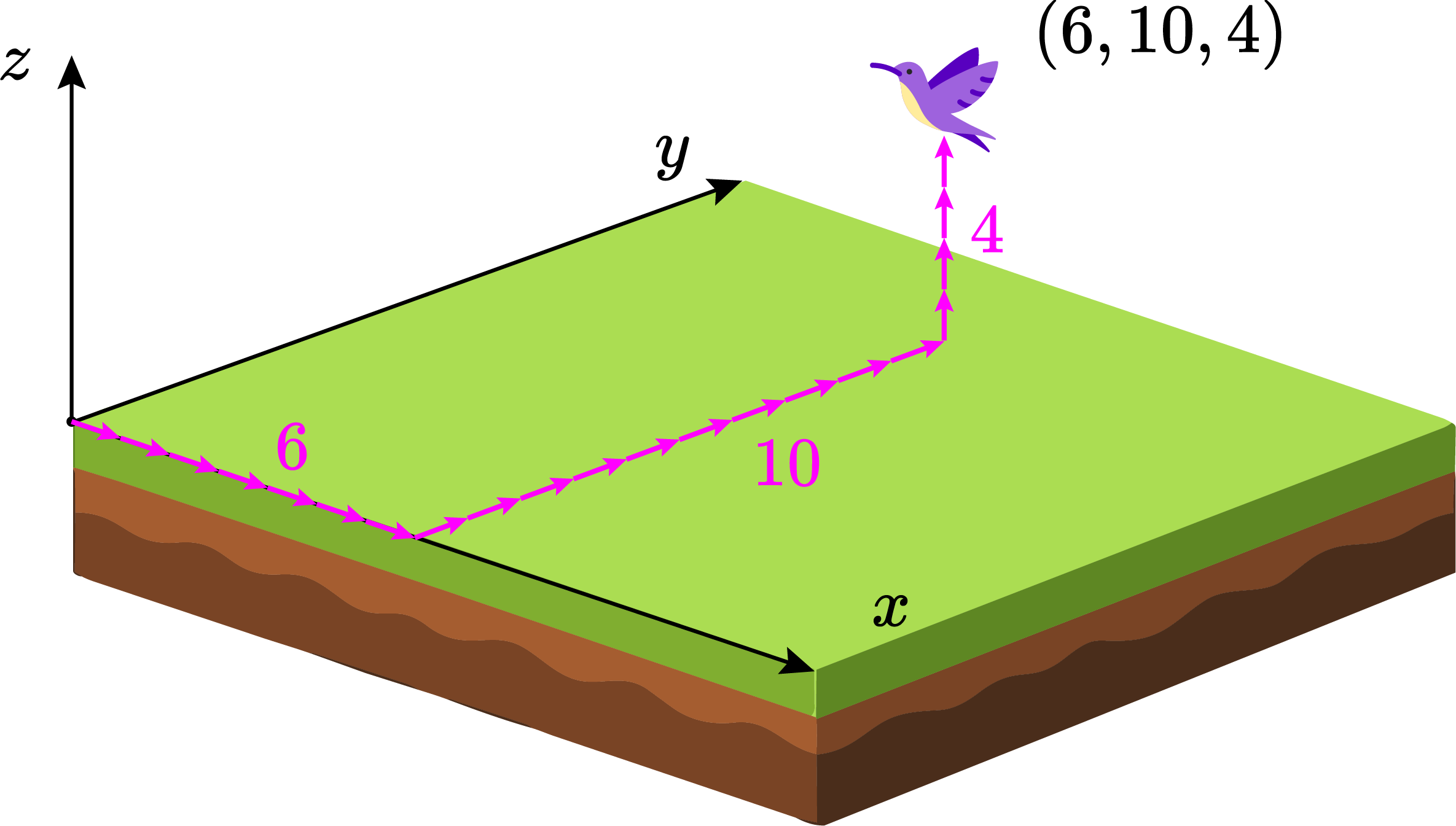
The familiar cartesian plane with (x,y) coordinates can be extended to 3D space by introducing a z coordinate, making a 3D coordinate have the form (x,y,z). Each component (x,y and z) tells you how many unit "steps" to take from the origin in the direction of each axis to reach the described point.
Angles in 3D
SL Core 3.1
By carefully imagining right triangles in 3D diagrams, we can find angles in space.
In the triangular prism below, we can find the length CB using Pythagoras. Then, since there is a right angle at C, we can write
tanθ=4√29⇒θ≈53.4∘
Spheres
SL Core 3.1
A sphere is a perfectly round, three-dimensional geometric shape where every point on its surface is exactly the same distance (the radius) from a single central point. It's the three-dimensional analog of a circle. For example, a ball or globe is spherical in shape. The surface area A and volume V of a sphere are given by:
AV=4πr2=34πr3
Cylinders
3. Prior learning
A cylinder is a three-dimensional geometric shape formed by two identical circular bases connected by a curved lateral surface. The segment connecting the centers of the circular bases is called the axis, which is perpendicular to each base in a right cylinder (the type usually studied).
The volume V of a cylinder with radius r is given by:
V=πr2h📖
The curved surface of a cylinder (excluding the circular ends) is given by:
A=2πrh📖
If we include the circular ends, each with area πr2, we get
A=2πr(r+h)🚫
Volume of a prism
3. Prior learning
A prism is a three-dimensional solid shape consisting of two parallel, congruent faces called bases, connected by rectangular lateral faces. Prisms are named according to the shape of their bases—for example, triangular prism, rectangular prism, or hexagonal prism.
The volume V of a prism is calculated by multiplying the area A of its base by its height h:
V=Ah
Right cones
SL Core 3.1
A right circular cone is a three-dimensional geometric shape whose apex (vertex) lies directly above the center of its circular base.
Key Parts:
Circular Base: Flat circle with radius r.
Apex (Vertex): The point directly above the center of the base.
Height (h): Perpendicular distance from apex to base center.
Slant Height (l): Distance along the cone's surface from apex to edge of base.
Formulas:
Volume:
V=31πr2h📖
Surface Area of curved surface:
A=πrl📖
Slant Height Relationship:
l=√r2+h2🚫
Right Pyramid
SL Core 3.1
A right pyramid is a three-dimensional shape with a polygonal base and triangular lateral faces, in which the apex (vertex) is located directly above the center (centroid) of the base.
Key Parts:
Polygonal base: a flat polygon (triangle, square, pentagon, etc.)
Apex (vertex): the point positioned vertically above the base's centroid
Height (h): perpendicular distance from apex to base centroid
Slant height (l): distance along a lateral face from the apex perpendicular to an edge of the base
The volume of a right pyramid is given by
V=31A×h
where A is the area of the base.
Applied triangle geometry
3 skills
Angles of elevation & depression
SL Core 3.3
Angles of elevation and depression describe how far upward or downward you look relative to a horizontal line when observing an object.
The angle of elevation is the angle formed by looking upward from the horizontal line to an object above your line of sight.
The angle of depression is the angle formed by looking downward from the horizontal line to an object below your line of sight.
These angles are always measured relative to a horizontal line, never vertical. Because the lines of sight form alternate interior angles with horizontal lines, the angle of elevation from one viewpoint equals the angle of depression from the other viewpoint.
True bearings
SL Core 3.3
A true bearing describes a direction measured clockwise from the north direction (0°) around a full circle up to 360°. Bearings are always given using three digits (e.g. 045°,120°,270°) to avoid confusion.
A bearing of 000∘ points directly north.
090∘ points east.
180∘ points south.
270∘ points west.
When working with true bearings, clearly draw a compass rose to visualize directions and measure angles clockwise from the north line.
One very useful fact about bearings is that returning in the direction something came from means adding or subtracting 180° from the original bearing - since it is doing a U-turn.
Whether you add or subtract depends on whether the original bearing is smaller or bigger than 180°, since the resulting bearing must be between 0 and 360°.
Angles in 3D
SL Core 3.1
By carefully imagining right triangles in 3D diagrams, we can find angles in space.
In the triangular prism below, we can find the length CB using Pythagoras. Then, since there is a right angle at C, we can write
tanθ=4√29⇒θ≈53.4∘